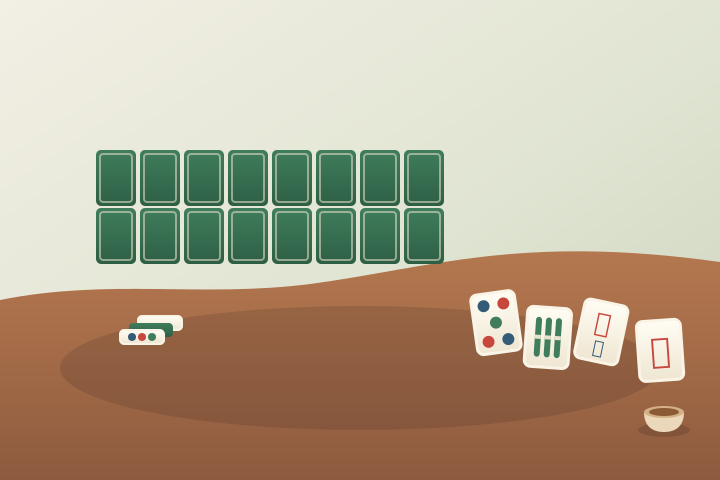
Who It Suits
Mahjong is a tile game for four players (or one, in the solitaire form) in which each player draws and discards tiles from a shared wall, quietly building a hand of thirteen tiles toward a winning shape: four melds — sequences of three consecutive tiles in one suit, or triplets of identical tiles — plus a pair. You win by completing your hand, either from a tile you draw yourself or from a discard that another player no longer needs.
The hobby rewards memory, probability, and patience. A beginner’s first games are mostly about learning the 144 tiles, following the draw-and-discard rhythm, and spotting the simple winning shapes; the deeper game — reading opponents’ discards, managing risk, and weighing which tile to keep — takes months of play to feel natural. The honest constraints are that it really wants four people (or a willingness to play the solo solitaire version), that the rules vary a lot between regional variants, and that a full game can run from twenty minutes to well over an hour. It suits people who enjoy card-like strategy, quiet concentration, and long social evenings around a table.
Mahjong is older than it looks. It developed in China during the Qing dynasty, in the early 19th century, and its name is commonly traced to the Chinese word for “sparrow shop,” a reference to the bird’s habit of picking up tiles. From China it spread to Japan, where the strict, competitive riichi variant was codified in the 1920s, and to the United States, where American mahjong developed its own rulebook and scoring. The single-player solitaire version, in which you clear a spread of tiles by matching pairs, became a global pastime in its own right.
Key Terms
A few words do most of the work in mahjong:
- Tile — one of the 144 pieces in a standard set (136 in Japanese riichi), each with a face and a plain back.
- Suit — the three numbered suits: characters (wan), circles (tong), and bamboo (tiao), each running from 1 to 9.
- Honor tile — the unnumbered tiles: the four winds (East, South, West, North) and the three dragons (red, green, white).
- Meld — a completed group of three: a sequence (three consecutive tiles of one suit) or a triplet (three identical tiles).
- Pair — two identical tiles; every winning hand needs exactly one.
- Hand — the thirteen tiles you hold, plus the tile you draw on your turn.
- Wall — the stacked rows of face-down tiles that players draw from.
- Discard — the tile you play face-up after drawing; opponents may claim it.
- Self-draw / discard win — completing your hand from a tile you draw, or from a tile another player discards.
- Riichi — the Japanese declaration that your hand is one tile away from winning, played face-down and worth extra points.
- Solitaire mahjong — the one-player version, in which you clear a spread of tiles by removing matching pairs.
Getting Started
Start with a standard 144-tile set — the same set works for most variants — and pick one rule set to learn first rather than sampling several at once. Japanese riichi is the most widely documented and has the cleanest written rules, while a basic Chinese house game is often the friendliest first experience if your group already plays one. If you only have one or two people to play with, the solitaire version is a perfectly good on-ramp: it teaches you the tiles and the suits without the pressure of opponents.
Basic Gear
Essential:
- One mahjong tile set (144 tiles for most variants, 136 for riichi).
- A table large enough for four players and their walls.
- A written rule sheet for the variant you are learning.
Optional at first:
- Tile racks to hold your hand and discards.
- A felt or rubber mat to keep tiles quiet and in place.
- A scoring app or chart for the variant you are playing.
First Session
Use the first session to learn the tiles before playing a full game. Go through the set together: the three numbered suits, the winds, and the dragons, and say each tile’s name out loud. Then deal a wall, take turns drawing and discarding for a few rounds, and let one player aim for a simple hand — say, a pair plus three sequences — while the others just follow the rhythm. You do not need to score correctly yet; the goal is to feel the draw, discard, and claim cycle.
A concrete first game: a basic Chinese or riichi hand where everyone plays for the simplest possible win. Keep a scrap of paper with the winning shapes on it, and after the game, look at each player’s final hand and name the melds and the pair. That review is where most of the learning happens.
First Month
During the first month, play the same variant every time so the rules stop being a puzzle and start being a habit. Work through the scoring for that variant slowly — learn the common winning hands first, and add the rarer high-scoring shapes later. Keep a note of the hands you win and the hands you nearly win, and try to name why a discard was good or bad after each game. If you are playing solo, mix in solitaire sessions to keep your tile recognition sharp between table games.
Costs
Mahjong is a one-off purchase that lasts for years: a basic plastic tile set is a modest cost, and sets in bone, bamboo, or premium materials cost more but are not necessary to learn or enjoy the game. Costs rise with tile racks, mats, and collecting different sets for different variants, and with tournament entry fees if you go that route. Because a set is reused for decades, the per-game cost is very low once you own one.
Space Needed
A standard four-player game needs a table roughly the size of a dining table, with room for each player’s wall, hand, and discards. A smaller table works for two-player or solitaire play. The tiles are small and light, so storage is easy — a set fits in a box or a drawer.
Solo or Social
Mahjong is at its best with four people: the game is built around reading three opponents’ discards, and the social table — tea, snacks, and long evenings — is half the appeal. It also has a strong solo form in the solitaire version, which is a quiet, self-paced matching puzzle you can play alone.
There is a competitive scene too. The World Mahjong Championship, held in Shanghai since 2005, is the biggest international event, with players from dozens of countries competing in the Chinese ruleset, and national and regional tournaments run riichi and other variants around the world.
Common Mistakes
- Learning several variants at once and never fully settling on one.
- Memorising scoring before you can reliably spot a simple winning hand.
- Ignoring opponents’ discards, which are the main source of information in the game.
- Chasing a high-scoring hand and throwing away a safe, simple win.
- Buying an expensive set before you know you will keep playing.
- Getting discouraged by the learning curve; the first few games are slow and fumbling, and that is normal.
Safety / Accessibility
Long sessions can strain the eyes, neck, and wrists, so good lighting, regular breaks, and a comfortable chair help. The tiles are small, so keep them away from young children and pets, where they are a choking hazard. If fine motor control is difficult, larger-tile sets and solitaire play are both easier to manage, and the game’s quiet, seated nature makes it accessible to many people who find noisier hobbies harder to join.
Where It Can Go
Mahjong can lead toward riichi or American mahjong, local mahjong clubs, online play, tournament competition, collecting different tile sets, or the single-player solitaire world. It also pairs naturally with tea, board games, and other long-table social evenings.
References
Last reviewed: 18 August 2026.
This guide is written for casual, at-home mahjong with a standard 144-tile set, with a brief note on the competitive scene. Rules and scoring vary widely between regional variants, so follow the written rule set for the variant your group is playing.
Sources and further reading:
- Mahjong — Wikipedia — a general account of the game’s Qing-dynasty origins in China, its spread to Japan and the United States, the tile suits and honors, and the major regional variants.
- World Mahjong Championship — the international tournament held in Shanghai since 2005, with players from dozens of countries competing in the Chinese ruleset.
Related Hobbies
Board games, cardistry, chess, billiards, and jigsaw puzzles all share the same blend of pattern recognition, careful odds, and quiet concentration around a table.