

Who It Suits
A board game is a game you play with other people around a table: a board, cards, tiles, or pieces, a set of rules, and a shared goal. A beginner’s first session is usually simple: learn the rules of one short game, set it up, play a full round, and see whether the group wants another. The same box can be a five-minute laugh, a family puzzle, or a two-hour strategy session, and the main constraints are having a table, a group, and enough time to finish the game.
Board games suit people who like shared attention, rules, tactics, negotiation, stories, or puzzles. The hobby can be light and social or deeply strategic depending on the games and group.
Quick Jump
- Key terms
- Beginner game finder
- Starter game table
- First session
- Game type guide
- Costs
- Casual, competitive, and collectible
- Finding people and places
- Buying checklist
- Rules learning
- Accessibility
- FAQ
Decision Snapshot
| Beginner question | Practical answer |
|---|---|
| Best for | People who enjoy repeatable social evenings, puzzles, table talk, light competition, teamwork, or tactical choices. |
| Not ideal for | People who dislike rules explanations, waiting between turns, scheduling groups, table clutter, or losing in front of others. |
| Starting cost | $0-$15 if you borrow, use a library, visit a board game cafe, or buy one small card game; $20-$50 for most gateway boxes; $60-$120 if you buy two or three starter games at once. |
| Space | A coffee table can handle many card games. A dining table is better for gateway games. Heavy strategy games often need a large table and several hours of undisturbed space. |
| Time | A useful first session is 20-60 minutes. First plays often take 25-50 percent longer than the box says because teaching and setup are included. |
| Social energy | Usually high. Solo modes exist, but the main beginner value is finding games that fit your actual people, not an imaginary perfect group. |
| First win | Finish one short game, understand why the winner won, and know whether your group wants another round, a different style, or a shorter teach next time. |
Key Terms
A few words do most of the work in board game shops, reviews, and at the table:
- Gateway game — an easy-to-learn game that introduces people to modern board games; a sensible first purchase.
- Teach — explaining the rules. “Teach time” is how long that takes before play starts, and it is separate from the listed play time.
- Downtime — the waiting time between your turns. Games with long downtime can bore players who want constant action.
- Player aid — a reference sheet or card that summarises the rules, so you do not keep the rulebook open.
- Solo mode — a way to play a game by yourself, usually through a rule variant or a companion app.
- Eurogame — a style, often from Europe, that emphasises resource management, indirect interaction, and player choice over luck and direct conflict.
- Worker placement — a mechanic where you place limited “workers” (often meeples) to claim actions.
- Tile-laying — placing tiles one at a time to build a shared board or map.
- Drafting — passing a hand of cards around the table and choosing one each round.
- Set collection — earning points by completing a set of matching items.
- Push-your-luck — a mechanic where you keep taking a risk for a bigger reward, but one failure ends the attempt.
- Legacy or campaign — a game that changes permanently across multiple plays (legacy) or a series of connected scenarios (campaign).
- Meeple — a wooden person-shaped piece; also a friendly word for a board gamer.
Getting Started
Start with one approachable game that matches the number of people you can actually gather. Learn it before game night, watch a short rules video, and choose a game with a play time your group can comfortably finish.
The safest beginner path is to buy or borrow for a real situation: two adults after dinner, four family members on a weekend, six friends who want laughs, or one person who wants a quiet solo puzzle. A famous game can still be wrong if it needs five players and you usually have two.
Beginner Game Finder
Use this page-local finder to narrow a first game for tonight. The examples are starter recommendations by fit, not a claim that one game is objectively best for everyone.
Find a first board game
-
Ticket to Ride
Best first family gateway game when people want a map, simple turns, and enough strategy to replay.
2-5 players, about 45-60 minutes, medium-light teach. -
Codenames
Best first party word game for mixed groups that like clues, table talk, and low component fuss.
4+ players, about 15-25 minutes, easy teach. -
Sushi Go
Best tiny-box starter when you want quick rounds, cute drafting, and a game that fits in a bag.
2-5 players, about 15 minutes, easy teach. -
Carcassonne
Best tile-laying gateway for people who like building a shared map and spotting simple scoring chances.
2-5 players, about 35-50 minutes, medium-light teach. -
Azul
Best abstract puzzle pick for quiet competition, beautiful components, and easy-to-see consequences.
2-4 players, about 30-45 minutes, medium-light teach. -
Pandemic
Best first cooperative game if the group wants to solve a shared crisis and discuss plans together.
2-4 players, about 45-60 minutes, medium teach. -
Kingdomino
Best short family tile game for younger players, casual adults, and people who want one more round.
2-4 players, about 15-25 minutes, easy teach. -
Just One
Best gentle party game when you want cooperative clues, almost no downtime, and low embarrassment.
3-7 players, about 20 minutes, very easy teach. -
Cascadia
Best quiet nature puzzle for solo, couples, and families who want pattern building without direct attacks.
1-4 players, about 30-45 minutes, medium-light teach. -
Jaipur
Best two-player starter for a compact head-to-head card game with quick decisions and little setup.
2 players, about 30 minutes, easy teach.
Starter Game Table
Prices vary by country, edition, sale, and availability. Use the ranges as planning guidance, then check current local prices before buying.
| Game | Game type | Players | Time | Age range | Learning difficulty | Table space | Typical price | Best fit |
|---|---|---|---|---|---|---|---|---|
| Ticket to Ride | Route-building gateway | 2-5 | 45-60 min | 8+ | Easy to medium | Dining table | $35-$60 | Families and mixed groups that want a classic first box. |
| Codenames | Party word game | 4+ | 15-25 min | 10+ | Easy | Small table | $15-$30 | Larger groups, parties, and people who enjoy clue-giving. |
| Sushi Go | Card drafting | 2-5 | 15 min | 8+ | Easy | Coffee table | $10-$18 | Travel, quick weeknights, and families wanting short rounds. |
| Carcassonne | Tile-laying | 2-5 | 35-50 min | 7+ | Easy to medium | Medium table | $25-$45 | People who like building maps, gentle tactics, and expansions later. |
| Azul | Abstract strategy | 2-4 | 30-45 min | 8+ | Easy to medium | Medium table | $30-$50 | Couples, families, and puzzle-minded players. |
| Pandemic | Cooperative strategy | 2-4 | 45-60 min | 8+ | Medium | Dining table | $30-$50 | Groups that prefer teamwork over direct competition. |
| Kingdomino | Tile-laying family game | 2-4 | 15-25 min | 8+ | Easy | Small table | $18-$30 | Families with younger players and people who want a fast teach. |
| Just One | Cooperative party word game | 3-7 | 20 min | 8+ | Very easy | Small table | $18-$30 | Low-pressure groups that want laughs without arguing. |
| Cascadia | Pattern-building puzzle | 1-4 | 30-45 min | 10+ | Easy to medium | Medium table | $30-$45 | Solo players, couples, and calm family tables. |
Visual Examples
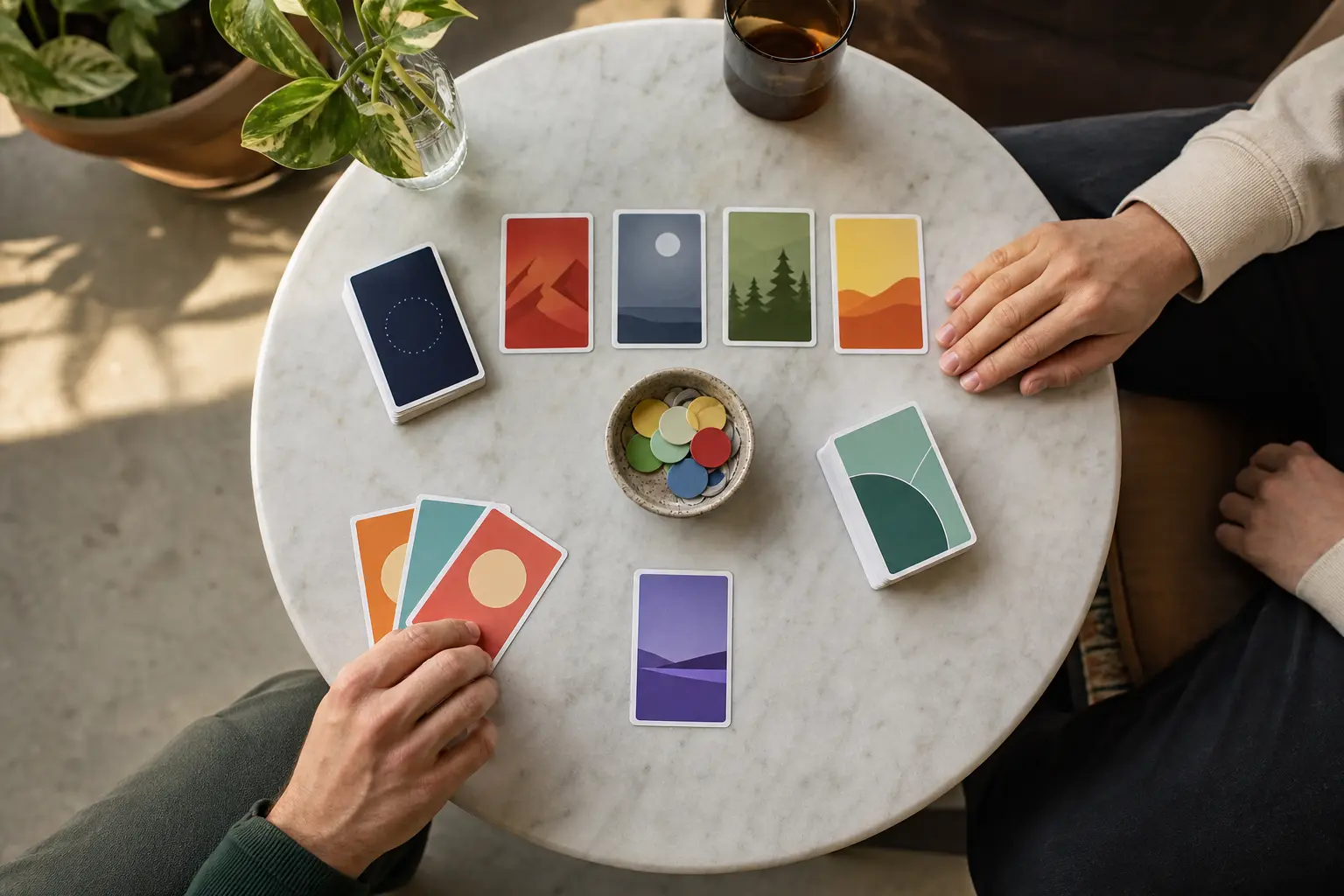
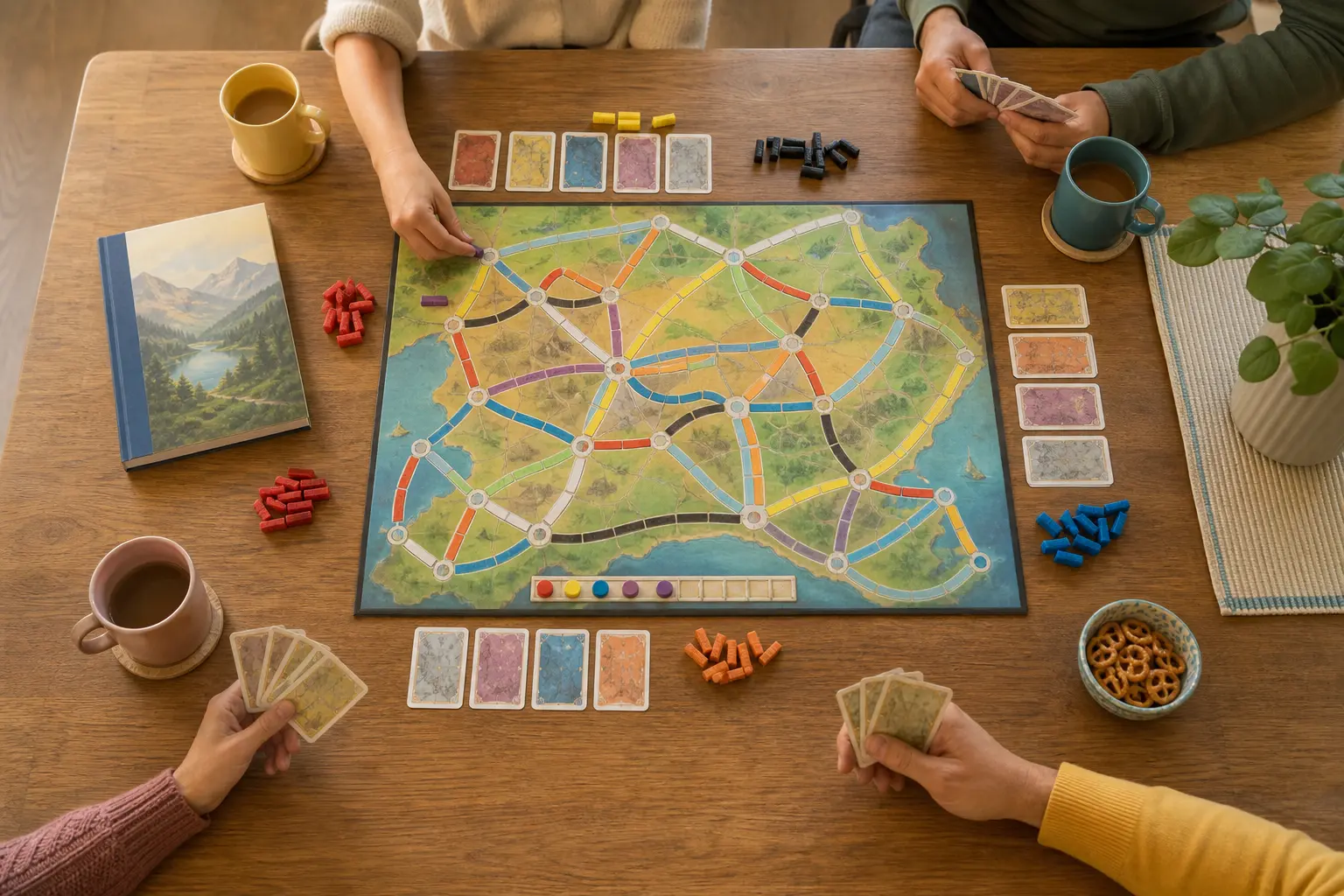
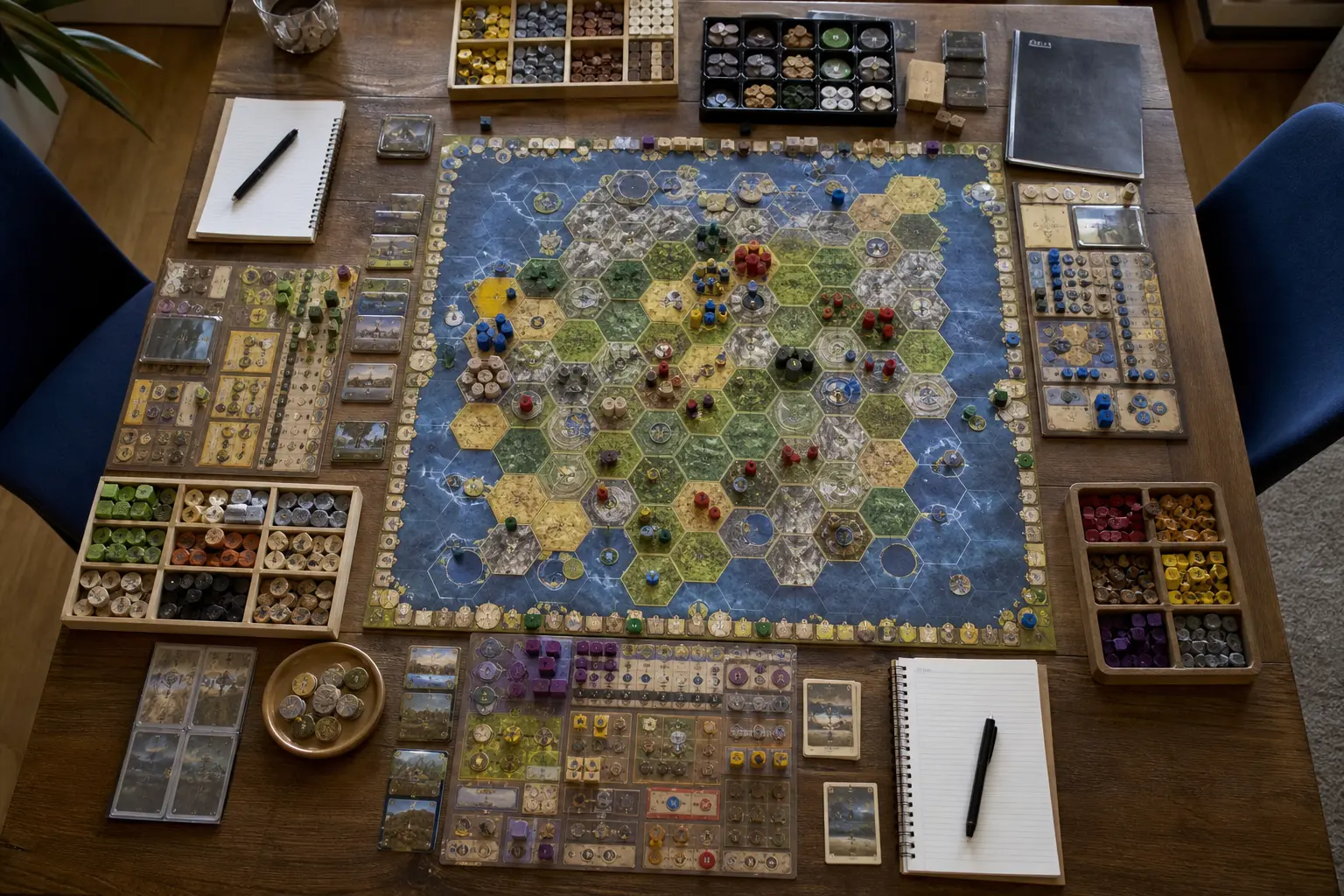
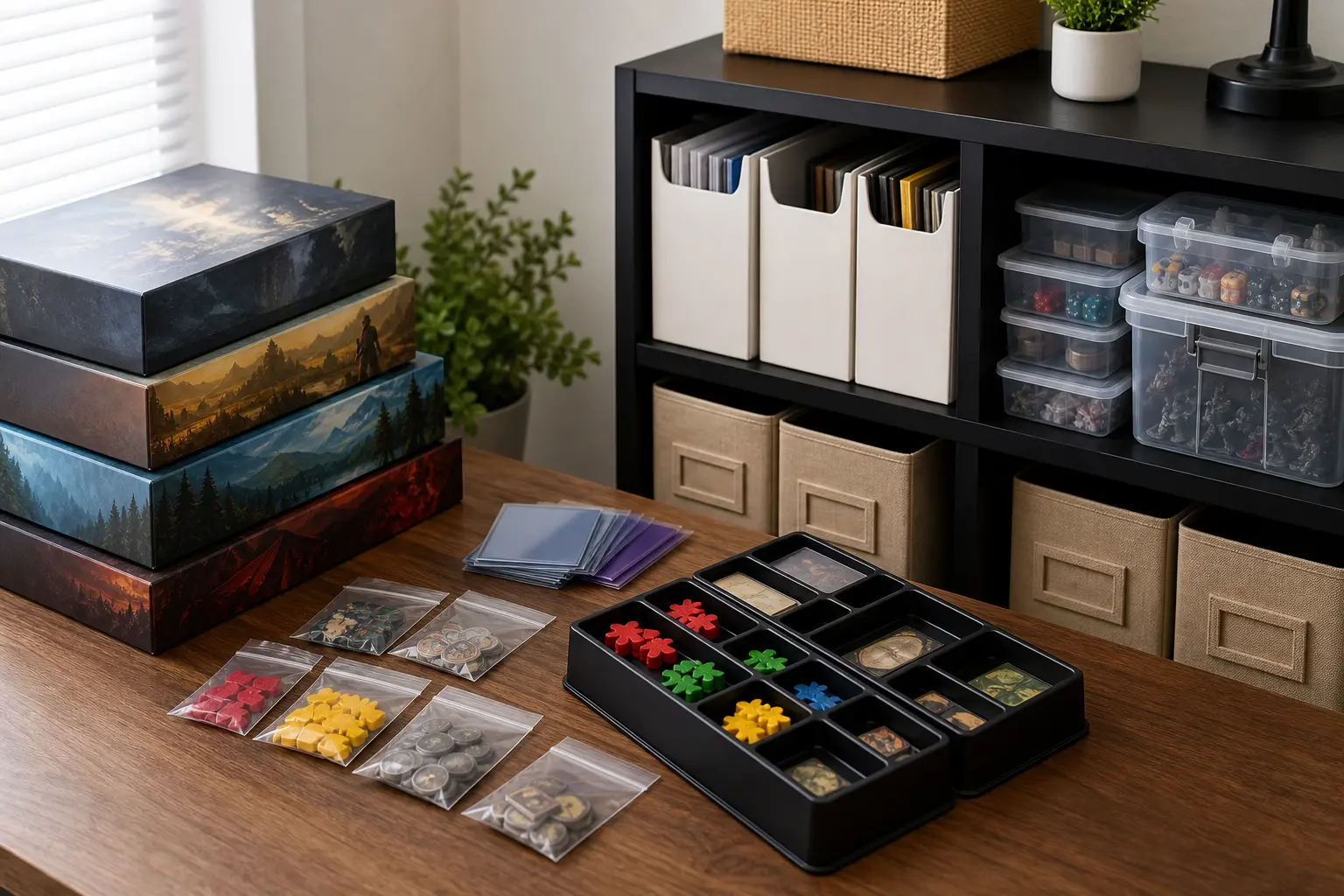
These illustrations show the practical difference between small, gateway, heavier, and accessory-heavy setups. They are not product photos or endorsement claims.
Basic Gear
- One beginner-friendly board game.
- Clear table space.
- Good lighting.
- Small bowls or trays for pieces.
- Rulebook or rules video.
- Notebook or app for games you want to try.
First Session
Use the first night to create a good experience, not to prove you bought the perfect game.
| Step | What to do | Why it helps |
|---|---|---|
| Choose one short game | Pick a game listed at 15-45 minutes, not a campaign, expansion-heavy game, or two-hour strategy box. | Beginners remember whether the evening ended well more than whether the game was prestigious. |
| Confirm player count | Check the real number of players and whether the game works well at that count, especially at two players. | Many boxes list a broad range but feel best only in the middle of that range. |
| Clear the table | Make room for the board, discard piles, player areas, snacks, drinks, and rulebook. | Crowded tables cause spills, hidden components, and slow turns. |
| Learn before people arrive | Watch one concise rules video, skim the rulebook, and set up a sample turn. | The host does not need mastery, but they should know the goal and turn structure. |
| Set expectations | Say the first round is a learning round and mistakes can be corrected generously. | This lowers anxiety and keeps one rules mistake from spoiling the evening. |
| Keep snacks away from components | Put drinks on a side table and use bowls for oily snacks. | Cards, boards, and tokens are harder to clean than plates. |
| Teach the core loop first | Explain the goal, what a turn looks like, and how the game ends before edge cases. | People learn faster when they know what decisions are coming. |
| Use a hard stop | Decide before starting when the table needs to wrap up. | A good short session beats a tired unfinished one. |
First Month
Try a few different types: cooperative, card-driven, tile placement, party, and light strategy. Notice whether your group prefers competition, teamwork, humour, theme, quick turns, or long planning.
Keep notes on player count, actual first-play time, who enjoyed it, and what caused friction. This matters more than online ratings because your group may value quick turns, low reading, or conversation more than depth.
Game Type Guide
| Type | Beginner examples | Suits | Avoid if |
|---|---|---|---|
| Party | Codenames, Just One, Wavelength-style clue games | Larger groups, casual nights, mixed skill levels, and people who want talking more than tactics. | Your group dislikes wordplay, attention, or team guessing. |
| Cooperative | Pandemic, The Crew, Forbidden Island-style games | People who prefer shared wins, family teamwork, and planning aloud. | One confident player tends to control everyone else’s turns. |
| Tile-laying | Carcassonne, Kingdomino, Cascadia | Visual builders, families, and people who like watching a shared layout grow. | Players need hidden plans or heavy conflict to stay engaged. |
| Deck-building | Dominion, Star Realms, Clank-style games | Players who enjoy improving a personal engine over repeated turns. | Shuffling, card text, and combo timing feel tedious. |
| Worker placement | Stone Age, Lords of Waterdeep-style games | People who like choosing limited action spaces and planning resources. | Blocking, scarcity, and medium rules overhead cause frustration. |
| Social deduction | One Night Ultimate Werewolf, The Resistance-style games | Groups that enjoy bluffing, reading people, and dramatic table talk. | Lying, suspicion, or being eliminated early feels unpleasant. |
| Abstract strategy | Azul, chess-adjacent designs, Onitama-style games | Couples, quiet competitors, and puzzle-minded players. | Theme, story, and table laughter matter more than clean tactics. |
| Campaign | Gloomhaven-style, legacy games, long narrative boxes | Committed groups that meet regularly and enjoy progression. | Your group is still unreliable or wants one-off evenings. |
| Dexterity | Klask, Crokinole, flicking or stacking games | People who want physical skill, laughs, and very short rules. | Fine motor demands, noise, or component impacts are a problem. |
| Solo | Cascadia, Friday, solo modes in many modern games | People who want a quiet puzzle without scheduling others. | The social side is the main attraction. |
| Heavy strategy | Terraforming Mars, Brass-style games, complex Euros | Patient players who enjoy systems, planning, and long arcs. | First-night success matters more than depth, or anyone hates long rule explanations. |
Fit Matrix
| Factor | You may love board games if… | You may tolerate them if… | You may dislike them if… |
|---|---|---|---|
| Social energy | You like shared attention and table conversation. | You enjoy small groups but need breaks. | Group focus drains you quickly. |
| Patience for rules | You enjoy learning systems and exceptions over time. | You can handle a short teach if the game starts quickly. | A rules explanation feels like work before fun. |
| Competition level | You enjoy winning, losing, and improving without taking it personally. | You prefer low-stakes scoring or cooperative games. | Losing creates tension or embarrassment. |
| Reading load | You are comfortable reading cards and player aids. | Icon-heavy games work if symbols are clear. | Small text, hidden hands, or lots of card effects are tiring. |
| Table space | You can clear a table for 30-90 minutes. | You can use compact card games or cafes. | You have no stable surface that can remain undisturbed. |
| Time blocks | You can protect an evening or regular short session. | You can play 15-30 minute games occasionally. | Your schedule is too fragmented for setup, teach, and cleanup. |
| Noise tolerance | Table talk, laughter, and disagreement can be part of the fun. | You prefer quieter puzzle games. | Overlapping voices or excited debate is stressful. |
| Group reliability | You know people who will show up or can use cafes and clubs. | You can play two-player or solo when plans fail. | The hobby depends on a group you cannot realistically gather. |
Costs
Board games can be cheap to try and expensive to collect. The beginner goal is to test what your group actually plays before buying shelves of possibilities.
| Budget path | What it looks like | Realistic first cost |
|---|---|---|
| Free or nearly free | Borrow from friends, use a library collection, attend a board game cafe with a cover charge, join a meetup, play print-and-play trials, or try digital implementations before buying. | $0-$15 |
| Budget card game | Buy one small-box game such as a drafting, word, trick-taking, or two-player card game. | $10-$25 |
| Gateway boxed game | Buy one mainstream starter box that fits your player count and table size. | $25-$60 |
| Small starter shelf | Buy one party game, one family gateway game, and one compact two-player or travel game. | $60-$120 |
| Accessories | Card sleeves, small bowls, bags, trays, storage boxes, score pads, or a playmat. | $5-$50+ |
| Expansions | Extra maps, cards, characters, campaigns, or modules for a game you already play often. | $15-$60+ each |
| Storage upgrades | Inserts, organizers, shelving, label boxes, or component cases. | $10-$100+ |
Buy used when components can be counted and inspected. Check that cards are not marked, boards are not warped, and all custom dice, player pieces, score pads, and rulebooks are present. Used gateway games can be excellent value because many people buy them, play once, and resell them.
Avoid the expansion trap early. An expansion makes sense when the base game is already getting repeated play and your group can explain what it wants more of. It does not fix a base game that was too long, too confusing, or wrong for your player count.
Treat any recommendation — from a store, a video, or a friend — as a starting point, not a verdict. A useful suggestion names the criteria it fits: player count, first-play time, language dependence, table space, age fit, and whether the game is still easy to buy. The goal is to avoid the wrong game, not just to point at the newest box.
Space Needed
Most games need a table and seating. Larger strategy games need more space and time, while card games can fit on a small table. Storage becomes the bigger issue if the collection grows.
Before buying a larger game, measure the table you actually use. A board, player boards, card markets, discard piles, resource trays, and drinks can turn a normal dining table into a cramped space. If space is tight, choose card games, tile games with small personal areas, or games that play well at a cafe.
Solo or Social
Board games are mostly social, though many modern games include solo modes. The hobby works best when you can find people with similar patience for rules, competition, and session length.
Two-player board gaming is its own strong lane. Some multiplayer games merely allow two players, while games like Jaipur, Patchwork-style puzzles, Onitama-style abstracts, many trick-taking variants, and several cooperative games are designed to stay interesting at two. Check two-player reviews before buying if your usual table is a couple or one friend.
Casual, Competitive, and Collectible
Most people play board games casually: a few games at home, borrowed or bought, with no stakes beyond the table. That is the default, and it is enough for most of the hobby.
Beyond casual play, the hobby has two other lanes that cost more time and money:
- Competitive and organized play. Some games run tournaments, leagues, and ranked events, and conventions host competitions. This is a commitment to practice, travel, and rules mastery, not a requirement for enjoying the games.
- Collecting. Games, first editions, out-of-print boxes, expansions, and miniatures can become a collecting hobby in their own right, with prices that rise for rare items. Collecting is optional and can get expensive; it is not needed to enjoy playing.
Finding People and Places
The hobby is easiest when you have a regular table, but you do not need to start with one:
- Local game stores often host free or low-cost game nights and can help you choose a first game.
- Public libraries in many areas lend board games like books, which is a low-cost way to test titles before buying.
- Board game cafes charge a cover or a drink minimum and let you play their collection.
- Meetup groups and clubs, online and in person, host regular sessions; ask whether they are beginner-friendly before attending.
Ask a store or group what they recommend for your player count and table size rather than buying on a ranking alone.
Buying Checklist
Before purchasing, check:
- Player count at your real table, not the ideal party you hope to host.
- Listed play time versus likely first-play time, which is often longer.
- Age range and whether younger players need reading, arithmetic, bluffing, or patience.
- Language dependence, especially if players read at different speeds or in different languages.
- Component quality, including card thickness, token readability, board clarity, and box size.
- Replayability without requiring an expansion immediately.
- Expansion dependence: some games feel complete in the base box, while others advertise many add-ons.
- Solo mode, if you want the game to survive cancelled plans.
- Setup and teardown time, not just play time.
- Whether the game works well at two players if that is your most common count.
Rules Learning
A poor first teach can make a good game feel bad. Prepare the teach like a short demonstration, not a lecture.
- Watch one concise rules video from a reputable teacher, then skim the rulebook to confirm setup and edge cases.
- Set up the game while learning so the physical layout explains the turn structure.
- Teach the goal first: how someone wins, loses, or completes the shared objective.
- Explain one turn: what a player can do, what choices matter, and what changes on the table.
- Play an open-handed example round where everyone can see why choices happen.
- Start the real game and introduce rare edge cases only when they appear.
- Keep the rulebook nearby and normalize quick checks instead of arguing from memory.
For cooperative games, assign final control of each turn to the active player. Advice is welcome; quarterbacking one person’s turn for them is not.
Common Mistakes
- Buying complex games before knowing your group’s taste.
- Teaching every rule before anyone has context.
- Letting one player control everyone’s decisions in cooperative games.
- Starting a long game too late.
- Collecting faster than you play.
- Buying expansions before the base game has earned repeat plays.
- Ignoring two-player quality when most sessions will be two-player.
- Letting snacks, drinks, pets, or small children share the same space as fragile components.
Safety / Accessibility
Board games are a low-risk hobby, but small pieces are a genuine choking hazard for young children — the standard safety threshold is under about three years old — so keep small components away from toddlers and follow the age rating on the box. The US Consumer Product Safety Commission tracks toy and game recalls, including small-part and choking hazards, so check for recalls on any game you buy, especially second-hand.
Choose games with readable text, clear colors, manageable turn length, and limited dexterity demands when needed. Digital aids can help with scoring and rules lookup.
| Accessibility area | What to check |
|---|---|
| Color vision | Prefer games that use icons, shapes, patterns, or labels in addition to color. Check whether common player colors are easy to distinguish under your lighting. |
| Icon-heavy design | Icons reduce reading once learned, but they can create a memory burden. Player aids and clear reference sheets matter. |
| Text size | Card-heavy games can be hard if text is small, italic, low-contrast, or held in hidden hands for long periods. |
| Hand management | Some players struggle to hold many cards. Card holders, open hands, or tableaus can help. |
| Dexterity demands | Flicking, stacking, speed, and precision games can exclude players with tremor, fatigue, pain, or mobility limits. |
| Hidden information | Secret hands and bluffing can be stressful for players who need help reading or processing rules. Cooperative or open-information games may work better. |
| Cognitive load | Avoid too many simultaneous scoring systems for the first night. Use player aids and teach only the next useful choice. |
| Downtime | Long waits between turns can be hard for children, tired adults, and attention-limited players. Choose simultaneous or quick-turn games. |
| Audio sensitivity | Loud party games, timers, and overlapping debate can be difficult. Quiet puzzle games or turn-based play may be more comfortable. |
| Cooperative quarterbacking | Some cooperative games invite one player to dominate. Set a table rule that the active player makes the final choice. |
| Digital aids | Companion apps, score calculators, rule summaries, magnifiers, and accessible digital rulebooks can reduce friction, but do not rely on an app without checking device access and battery life. |
Trust Signals
This guide chooses examples by beginner fit: clear rules, realistic player counts, availability, typical cost, table space, first-play time, replay value, and how often the game solves a common beginner situation such as family night, two-player evenings, parties, cooperation, travel, or quiet strategy.
It does not claim lab testing, universal rankings, or that every named game is right for every group. Board game availability, editions, prices, and community consensus change, so recommendations should be revisited when games go out of print, prices shift, rules editions change, or better beginner options become widely available.
References
Last reviewed: 17 August 2026.
This guide is written for casual and beginner board gaming at home or in a group. It is not a ranking of the best games, a buying service, or a substitute for checking a specific game’s current rules, edition, and availability. Prices are common US planning ranges and vary by country, edition, and sale.
Official and authoritative sources:
- Spiel des Jahres — a critic’s award for board and card games, presented since 1979 by the Spiel des Jahres association. Its family (Spiel des Jahres), children’s (Kinderspiel des Jahres), and connoisseur (Kennerspiel des Jahres) categories are a useful quality marker when choosing a first family or gateway game.
- US Consumer Product Safety Commission: Toys — the US safety authority for toy and game recalls, including small-part and choking hazards. Check here before buying, especially second-hand.
Community resources (optional):
- BoardGameGeek — the largest community database of board games, with player counts, play times, age ranges, complexity ratings, and reviews. Treat its rankings as community consensus and practical context, not an official standard.
- Local game stores, public library game collections, board game cafes, and meetup groups remain the best sources for choosing a first game and finding people to play with.
Where It Can Go
Board games can lead toward roleplaying games, miniature painting, chess, game design, card games, conventions, reviewing, collecting, or hosting regular game nights.
Frequently Asked Questions
What is the best board game for beginners?
The best beginner board game is the one that fits your real player count, time limit, and group mood. Ticket to Ride, Codenames, Sushi Go, Carcassonne, Azul, Pandemic, Kingdomino, Just One, and Cascadia are all reasonable starter candidates for different tables.
How much do board games cost to start?
You can start for $0-$15 by borrowing, using a library, visiting a board game cafe, or buying a small card game. A typical gateway boxed game often costs about $25-$60, while a small starter shelf can reach $60-$120 if you buy several games at once.
What should I buy first?
Buy one short game that matches the people you can actually gather. For many beginners, that means one party game for larger groups, one gateway family game for 2-5 players, or one compact two-player game for couples and roommates.
Can two people play board games?
Yes. Many modern games work at two, and some are built specifically for two players. Check two-player quality before buying because a box that says 2-5 players may still feel best with three or four.
How long does a board game night take?
A beginner-friendly game night can be 60-90 minutes including setup, teaching, one short game, and cleanup. First plays often take longer than the box estimate, so avoid starting a 90-minute game late in the evening.
Where can I find people to play with?
Start with friends, family, coworkers, local board game cafes, libraries, community centers, hobby shops, campus groups, and online meetup groups. Ask whether events are beginner-friendly before attending.
How should I learn board game rules?
Watch one concise rules video, set up the game while learning, teach the goal first, explain a turn, play an open-handed example, and look up edge cases only when they arise.
How do I avoid buying the wrong game?
Check real player count, first-play time, two-player support, table space, reading load, age range, setup time, and whether your group wants competition, cooperation, laughs, or quiet puzzles. Borrow or play at a cafe before buying expensive or complex games.
Related Hobbies
Chess, model making, painting, creative writing, comics, photography, and cooking can all connect with tabletop gaming.