Who It Suits
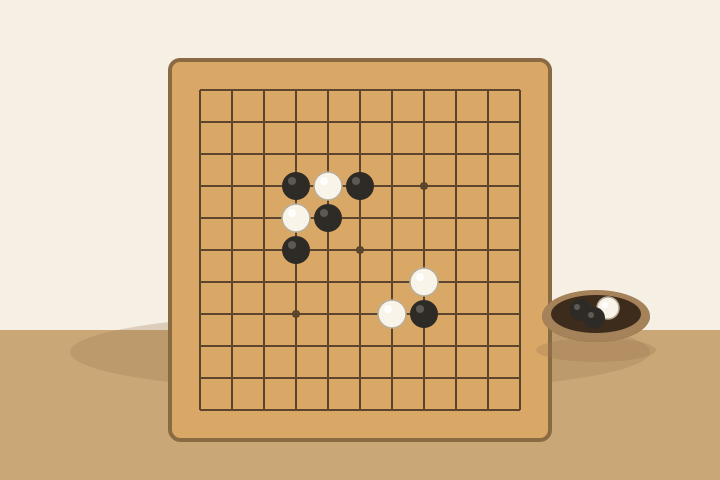
Go suits people who enjoy quiet competition, seeing the whole board at once, and improving slowly through repetition. It can be casual, social, or deeply serious depending on how you approach it, and its calm pace suits people who prefer thinking over fast reflexes.
Getting Started
Learn the three core ideas: stones are placed on the intersections rather than in the squares, a stone or connected group is captured when all of its liberties are filled, and the game ends when both players pass, with the winner surrounding more territory. Start on a small 9x9 board so games finish in one sitting, then move up to 13x13 and the full 19x19 once the rules feel natural.
Basic Gear
- A Go board and a set of black and white stones, or a free app or website.
- A beginner rules guide or a short rules video.
- A small bowl or tray for stones, optional at first.
- A notebook if you want to record lessons.
- A clock later, not on day one.
First Session
Play one full 9x9 game. Place stones in the corners and along the edges, keep your groups alive by giving them room, and try to capture a few of your opponent’s stones. Afterward, look at the finished board and find one group that was in danger, then write down why it was in trouble.
First Month
Play lots of short 9x9 games and learn the basic building blocks: liberties, capturing, ladders, nets, life and death with two eyes, and the value of the corner, edge, and centre. Learn the etiquette too: bowing before a game, picking up stones with two fingers, and passing when you have nothing useful to play. Finish the month with a 13x13 game to feel how the scale changes.
Costs
Go is one of the cheapest games you can play. It is free online, and a basic board and stones cost less than a boxed board game. Wooden gobans, slate or glass boards, tournament stones, club fees, and coaching are optional later costs.
Space Needed
A full 19x19 board is about the size of a large book and stores flat, while a 9x9 board fits in a bag. All you need is a stable surface, two chairs, and a little patience.
Solo or Social
Go is a two-player game, but it is easy to study alone: problems (tsumego), reviewing finished games, and playing against an app all work without a partner. Clubs, cafés, and casual meetups make it social, and the slow pace means players often talk between moves.
Common Mistakes
- Starting on a 19x19 board before the rules feel natural.
- Playing every stone next to your own groups instead of spreading out.
- Ignoring the opponent’s big moves.
- Forgetting to count liberties before capturing.
- Abandoning a losing game instead of learning from the end.
Safety / Accessibility
Go is low-risk physically. Larger boards, high-contrast stones, magnetic boards, and digital play can make it easier for people with visual or motor needs. The pace is self-determined, and long games can be paused and finished later.
Where It Can Go
Go can lead toward club play, tournaments, correspondence Go, problem study, teaching, the history of the game in Japan, China, and Korea, or a quiet lifelong game with friends.
References
Last reviewed: 20 August 2026.
Official rules and learning:
- American Go Association for beginner tutorials, club discovery, rated play, and learning resources.
- American Go Association: The Rules of Go for concise and complete rules resources, including the AGA ruleset.
Related Hobbies
Chess, board games, crossword puzzles, coding puzzles, journaling, and model making all appeal to patient strategic thinkers.