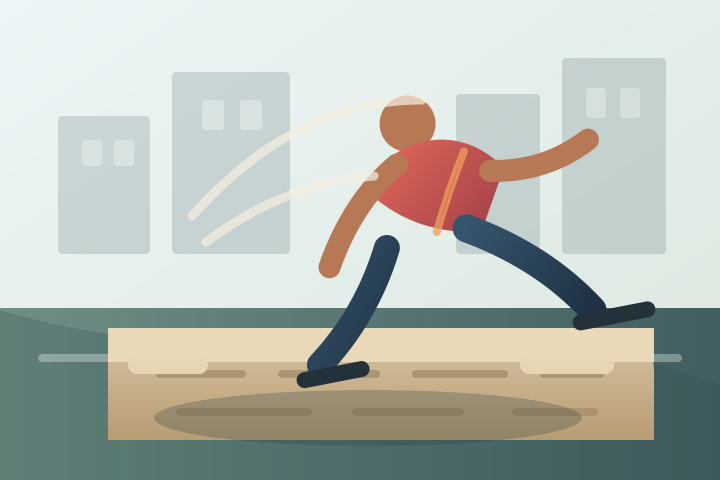
Decision Snapshot
Parkour is a movement discipline for getting from A to B through whatever is in the way: running, jumping, climbing, vaulting, balancing, and rolling over, around, and through the obstacles in your path. It emerged in the Paris suburbs in the early 1990s, built by David Belle and the group that became the Yamakasi on the physical-education methods of Georges Hébert, and its name comes from the French parcours du combattant, the military obstacle course. A beginner’s first sessions are much smaller than the clips you see online: quiet two-foot landings, a shoulder roll, balance walks on low rails, precision steps onto low walls, and simple vaults over waist-high obstacles — usually in a public park, a purpose-built parkour park, or an indoor parkour gym.
| Beginner question | Practical answer |
|---|---|
| Best first step | A beginner class, coached session, or local club that teaches progressions rather than big jumps. |
| Typical first-session cost | $0 in a public park; roughly $20-$80 for a beginner class or workshop; $10-$30 for an indoor parkour gym day pass. |
| Weekly time commitment | 1-2 sessions of 60-90 minutes for steady progress; 30-45 minutes of landing and balance drills is enough to start. |
| Space requirement | A safe, legal space with low walls, rails, steps, or a purpose-built parkour park. A flat open area is enough for the first few weeks. |
| Difficulty | High. The basics are simple, but safe landings and rolls take repetition, and the activity is high-impact. |
| Fitness level | Moderate to high. You do not need to be athletic to start, but you must build up gradually. |
| Social level | Flexible: solo drills, small group training, or coached classes. Group etiquette matters in public spaces. |
| Good fit if | You like physical problem-solving, enjoy the outdoors, and accept slow, careful progression. |
| Bad fit if | You need low-impact exercise only, dislike falling, have no safe local space, or want quick flashy results. |
Who It Suits
Parkour suits people who like practical movement, physical problem-solving, and the outdoors. The appeal is not the spectacle — it is the feeling of moving through a familiar environment in a new way, and the steady, repeatable progress that comes from drilling landings, rolls, vaults, and balance until they are reliable. It can be playful and low-impact at the basics, or progress toward demanding wall work, drops, and linked movement lines.
The realistic constraints: parkour is a high-impact activity built on jumps, landings, and the occasional fall, it needs access to safe and legal training space, and progress is slow by design. The community’s own motto is “être et durer” — to be and to last — which points the other way from the big-jump culture of online clips. It is not a shortcut to fitness, and it is not the same as the acrobatic freerunning that is often shown in videos.
This guide is written for beginners deciding whether parkour fits their body, budget, and local training options. Cost and difficulty estimates assume casual coached or self-directed practice in parks and gyms, not competitive, stunt, or film work.
Key Terms
A few words do most of the work in parkour classes and on the training ground. Names vary between groups and countries; the French terms are the most common.
- Traceur / traceuse — a parkour practitioner (masculine/feminine), from the French verb tracer, “to trace a path”.
- Jam — a training gathering, often lasting hours or days, with practitioners from different cities.
- Landing (réception) — a controlled, quiet landing on the balls of your feet with soft knees; the heels stay off the ground.
- Roll (roulade) — a shoulder roll along the diagonal of the back that spreads the energy of a fall. It is not the gymnastics forward roll, which is dangerous in parkour because the head can hit the ground.
- Precision jump (saut de précision) — a two-footed hop without a run-up, landing on a small surface such as a low wall.
- Speed vault (passement rapide) — the classic vault over a low obstacle: one hand on the obstacle, the far leg swings through first.
- Lazy vault (saut de paresseux) — a one-hand vault where the near leg goes through first; easier on the shoulder.
- Bar vault (passe barrière) — moving over a rail or barrier with both hands, legs swinging through.
- Wall step (passe-muraille) — placing a foot on a wall to reach a higher hold or the top.
- Muscle-up (planche) — pulling your body up to the top of a bar or wall while hanging.
- Cat leap (saut de chat) — diving onto a wall with your hands and swinging your legs up between your arms.
- Tic-tac — a quick push off a wall or side surface to change direction or gain height.
- Drop (saut de fond) — a controlled fall from height, usually finished with a roll.
- Flow — linking several movements smoothly into one continuous line.
- Freerunning — a related but distinct style that emphasises acrobatic, expressive movement (flips, spins, tricks) over efficiency.
- L’art du déplacement — “the art of movement”; the official French term, used by the Ministry of Sports, for the family of these activities.
Getting Started
Start with instruction, not imitation. The single best first step is a beginner class, a coached session, or a local club that teaches progressions — landing, rolling, vaulting, balance — rather than big jumps. If that is not available, practise the ground-level basics in a safe, legal, quiet space: soft two-foot landings, a shoulder roll from a low step, balance walks, and precision steps onto a low wall.
Learn the order in which skills are usually taught:
- Landing — controlled, quiet landings on the balls of your feet with soft knees.
- Rolling — dissipating a fall along the diagonal of your back, the way judo and aikido rolls work.
- Balance — walking low rails, beams, and walls.
- Precision — stepping or hopping from one small surface to another.
- Vaulting — using your hands to move over low obstacles.
- Wall work and drops — only once the above are consistent, and with coaching for anything with real height.
The early goal is controlled movement, not risk. A movement you can repeat ten times without strain is a learned movement; one you can do once is not.
Basic Gear
Start With The Essentials
| Item | Budget option | Mid-range option | Buying guidance |
|---|---|---|---|
| Shoes | $40-$80 flat, grippy trainers you already own | $60-$120 dedicated flat-soled trainers with a grippy rubber sole | Grip and a flat, stable sole matter more than brand. Running shoes have soft, cushioned soles built for forward motion and can feel unstable on rails and walls. |
| Clothing | Existing athletic clothes | Moisture-wicking shirt, joggers or shorts, socks | Nothing that snags on obstacles; avoid loose hems and long drawstrings. |
| Water bottle | Any reusable bottle | Insulated bottle for outdoor sessions | Hydration matters, especially in heat. |
| Small towel or spare layer | Any | Outdoor sessions in parks involve ground contact and sweat. | |
| First-aid basics | A small kit with plasters and antiseptic wipes | Scrapes are part of the hobby; treat them the same day. | |
| Class booking or gym pass | Free public park | $10-$30 per visit or a monthly pass | The most important “purchase” is instruction or a safe space. |
Optional Upgrades Later
| Upgrade | Typical cost | When it makes sense |
|---|---|---|
| Phone tripod or clip | $10-$40 | Once you want to film your own technique for review. |
| Home mat | $30-$100 | For practising rolls and landings at home on a forgiving surface. |
| Strength training membership | $30-$80/month | When your joints and tendons need a strength base between parkour sessions. |
What not to buy first: expensive “parkour shoes” before you know you will keep training, wrist guards as a substitute for learning to fall, or any gear that promises to make big jumps safer.
Visual Learning Assets
First Session
A realistic first 60-90 minutes, coached or self-directed in a safe, legal, quiet space:
- Warm-up (10 min) — light jog or brisk walk, ankle and hip circles, calf raises, a few easy two-foot hops.
- Landings (15 min) — small two-foot hops, landing quietly on the balls of your feet with soft knees. Then step down from a low step (10-20 cm), landing softly.
- Rolls (10 min) — practise the shoulder roll from a low step or a mat, then from a small drop. If you are learning uncoached, keep it to a mat and a low step.
- Balance (10 min) — walk a low rail, beam, or wall edge, both directions, with your gaze forward.
- Precision (10 min) — step or hop between low walls or blocks, both feet landing together.
- Vaults (10 min) — speed vault and lazy vault over a waist-high or lower obstacle, from both sides.
- Cool-down (5-10 min) — walk, gentle stretches, and a note on what felt controlled and what did not.
Stop while your focus and your legs still feel reliable. A tired session on hard ground is where most beginner injuries happen.
First Month
Train once or twice a week while your joints, wrists, ankles, and confidence adapt.
| Week | Focus | You are ready to move on when |
|---|---|---|
| 1 | Landings and rolls | You can land a small drop quietly and roll without bracing. |
| 2 | Balance and precision | You can walk a low rail both ways and hop between small surfaces without looking at your feet. |
| 3 | Vaulting | Speed and lazy vaults feel controlled from both sides over low obstacles. |
| 4 | Wall steps and short lines | You can step up a wall and link two or three movements into a simple line. |
Add height, distance, speed, and linked movements only when each progression is consistent. One new stressor at a time — a higher wall, a longer gap, a faster line — not all in the same week.
Costs
Parkour can be almost free if you have access to a public park and decent shoes. Costs rise with instruction, indoor access, and travel.
| Beginner scenario | Typical cost | Notes |
|---|---|---|
| Public park or green space | $0 | The lowest-cost route if the space is safe, legal, and quiet. Weather and surface condition are the trade-offs. |
| Beginner class or workshop | $20-$80 per session | The best first purchase for most people; you learn landings and rolls correctly. |
| Indoor parkour gym day pass | $10-$30 per visit | Weatherproof, matted, and usually supervised. Costs add up. |
| Monthly gym or club membership | $30-$100/month | Worth it once you are training regularly. |
| Flat, grippy trainers | $40-$120 | The one piece of gear that genuinely matters. |
| Travel to a training spot | Varies | Factor in transport if your nearest safe space is far. |
| Strength training | $0-$80/month | Optional but useful for joints and tendons. |
These are typical US and Western European ranges as of 2026 and vary a lot by region and city; check local clubs and gyms for current prices.
Low-cost tips: use public parks at quieter times, buy a durable pair of flat grippy trainers before anything else, practise the ground-level basics instead of paying for every session, and join a coached class before committing to a gym membership.
Space Needed
Parkour needs safe, legal spaces with stable surfaces and obstacles such as low walls, rails, steps, gym boxes, mats, or purpose-built training areas.
| Space | What you get | What to check |
|---|---|---|
| Public park | Free, flexible, low obstacles. | Surface condition, crowding, local rules, and whether the area is meant for training. |
| Purpose-built parkour park | Designed obstacles, often matted. | Availability, maintenance, and local rules. Some French cities, for example, have opened dedicated public parkour areas. |
| Indoor parkour gym | Mats, boxes, rails, supervision, weatherproof. | Fees, beginner sessions, and whether visitors are allowed. |
| Gymnastics or calisthenics gym | Repurposed equipment, boxes, bars. | Permission to use the equipment for parkour-style work. |
| Quiet street or plaza | Real-world obstacles. | Traffic, pedestrians, property rules, and whether you are allowed to be there. |
Avoid roofs, private property, fragile structures, wet rails, traffic, crowded walkways, and drops you cannot confidently climb down from. Training in public space can raise trespassing and property issues that vary by city and country; ask local practitioners or a club where training is accepted, and leave the area as you found it.
Solo or Social
Parkour can be practised alone at a basic level, but it is often better with coaches or training partners. Other practitioners can check technique, suggest progressions, spot unsafe choices, and make repetitive drills more enjoyable. Group etiquette matters in public spaces: keep groups small, avoid blocking walkways, ask before using someone’s equipment or space, and leave the area as you found it.
Parkour Variants
| Variant | Best for | Beginner caution |
|---|---|---|
| Classic parkour | Efficient, practical movement through the environment. | Still high-impact; learn landings and rolls first. |
| Freerunning | Acrobatic, expressive movement — flips, spins, and tricks. | Flips are advanced and high-risk; they are a separate skill tree, not a parkour progression. |
| Indoor parkour | Weatherproof, matted, supervised practice. | Costs money; some gyms are performance-oriented. |
| Parkour fitness / calisthenics | Strength and conditioning using parkour movements. | Lower risk; a good on-ramp or complement. |
| Competitive parkour | Speed-run and freestyle events. | In France, parkour was integrated into the gymnastics federation (FFGYM) in 2006, and speed-run and freestyle were first contested at the 2022 World Games in Birmingham. Competition is a later step, not a starting point. |
| Adaptive parkour | Lower-impact, balance-focused, or wheelchair-inclusive movement. | Find an adaptive coach or program for suitable equipment and guidance. |
Freerunning is worth knowing by name: it grew out of parkour in the early 2000s, associated with Sébastien Foucan and the acrobatic style that emerged from the Yamakasi split, and emphasises artistry over efficiency. The line between the two has blurred, and many practitioners now treat flips as part of parkour — but for a beginner the distinction matters: efficiency first, acrobatics later.
Parkour Vs Other Hobbies
| Hobby | Fitness | Cost | Space/access | Social level | Best reason to choose it |
|---|---|---|---|---|---|
| Parkour | High-impact: jumps, landings, falls. | Low if public space is available. | Needs safe, legal obstacles. | Flexible. | You want practical movement skills and outdoor problem-solving. |
| Rock climbing | Moderate to high, grip and balance. | Moderate (gym fees, gear). | Needs a wall or crag. | Medium to high. | You want puzzle-like progression with built-in safety systems. |
| Calisthenics | High, strength-focused. | Low. | A bar or open space. | Low to medium. | You want strength without jumps or falls. |
| Running | Cardio, low skill ceiling. | Low. | Most flexible access. | Low alone, medium with clubs. | You want simple, low-impact cardio. |
| Gymnastics | High, technical. | Moderate. | A gym with apparatus. | Medium. | You want coached acrobatics on safe equipment. |
| Skateboarding | Moderate to high, balance. | Moderate (board, pads). | Open pavement. | Medium to high. | You want rolling movement and a strong community. |
Common Mistakes
| Mistake | Why it hurts progress | Beginner fix |
|---|---|---|
| Chasing big jumps before mastering landings | Falls from height are where serious injuries happen. | Keep everything low to the ground for the first months. |
| Copying online clips without the unseen progressions | The video shows the last 1%, not the 99% of practice. | Learn the progression from a coach or a structured program. |
| Training tired on hard surfaces | Fatigue collapses technique and raises injury risk. | Stop while your focus and legs still feel reliable. |
| Skipping the roll | A bad fall becomes a wrist or shoulder injury. | Learn the shoulder roll early and repeat it until it is automatic. |
| Using shoes with poor grip or unstable soles | Slips on rails and walls. | Use flat, grippy trainers; avoid soft running soles. |
| Ignoring property rules or public space etiquette | You can be asked to leave, fined, or shut down a training spot for everyone. | Ask local practitioners where training is accepted; keep groups small and clean. |
| Adding height, distance, and speed at once | Multiple new stressors multiply risk. | One new stressor at a time. |
Safety and Accessibility
Sprains, wrist strain, knee pain, falls, scrapes, and collisions are the main risks. Parkour is often described as an extreme sport because of its spectacular image, but the community’s own motto — “être et durer” (to be and to last) — points the other way: slow, careful progression is the point.
| Safety area | Practical beginner guidance |
|---|---|
| Warm-up | 5-10 minutes of light cardio and joint mobility before any jumping. |
| Landing mechanics | Land on the balls of your feet with soft knees, quiet and controlled. Never land with locked knees. |
| Rolling | Learn the shoulder roll from a low step or a mat before any drop. It is different from a gymnastics forward roll. |
| Wrists and ankles | Build strength gradually; consider a coach if you have prior sprains or pain. |
| Surface inspection | Check for wet, loose, or uneven surfaces before each session. |
| Weather | Wet rails and cold concrete change what is safe. Reduce intensity in heat; take shade breaks. |
| Gradual progression | Add one stressor at a time: height, distance, speed, or complexity. |
| Coaching | Use coaching for rolls, vaults, and anything with real height. |
| Public space | Stay legal, keep groups small, avoid crowds and traffic, and leave the area as you found it. |
| Adapted options | Lower-impact parkour, indoor gyms, adaptive movement coaching, and balance-focused drills can make the hobby more accessible. |
References
Last reviewed: 18 August 2026.
This guide is written for beginner discovery. It is not legal advice, medical advice, or a substitute for local coaching. Legal access to public space, minimum ages, and home-practice rules vary by country, region, city, and venue, so confirm local requirements and ask local practitioners where training is accepted.
Official and institutional sources:
- Parkour — Wikipedia (English) — a tertiary reference for the discipline’s definition, history (David Belle, the Yamakasi, Georges Hébert), etymology, and the World Freerunning and Parkour Federation (est. 2007).
- Parkour — Wikipédia (français) — a tertiary reference for session structure, movement vocabulary, the French Ministry of Sports’ “l’art du déplacement” framework, the 2006 FFGYM integration, and the 2022 World Games events.
The authoritative bodies named above — the French gymnastics federation (FFGYM), the French Ministry of Sports, and the World Freerunning and Parkour Federation — are documented through those references; direct federation links were not independently verified at review time.
Community resources (optional):
- Parkour.org — a German network of parkour organisers offering beginner workshops, club training, trainer education, and holiday camps; practical but commercial, so treat it as a local entry point rather than an authority.
Where It Can Go
Parkour can lead toward freerunning, obstacle course racing, stunt training, calisthenics, climbing, gymnastics, coaching, filmmaking, photography, community events, or urban exploration with a stronger safety mindset. In France, parkour techniques are used by the Paris fire brigade, and the discipline sits within the national physical-education tradition through the “l’art du déplacement” framework recognised by the Ministry of Sports.
Related Hobbies
Freerunning and calisthenics are the closest cousins if you want a different flavour of the same movement. Rock climbing shares the balance and problem-solving, while gymnastics offers coached acrobatics on safe equipment. Running supports the cardio base that parkour builds, and skateboarding offers a rolling, community-rich alternative. Photography and filmmaking are natural companions for documenting progress.
Frequently Asked Questions
Is parkour expensive to start? No, not if you have access to a free public park and already own grippy trainers. A practical start can be one pair of flat, grippy shoes and a water bottle. Costs rise with classes, indoor gym access, travel, and better shoes.
Do I need to be athletic to start? No. You need to be willing to repeat basic movements — landings, rolls, balance — many times. The first sessions are low to the ground and can be gentle. Full-speed lines and drops are much more intense, so build up gradually.
Can I learn parkour from videos? Videos are useful for seeing what a movement looks like, but they hide the progressions, the coaching cues, and the safety checks. Learn the basics from a coach or a structured program before attempting anything with height or distance.
What is the difference between parkour and freerunning? Parkour emphasises efficient, practical movement through the environment. Freerunning emphasises acrobatic, expressive movement — flips, spins, and tricks. The line has blurred, and many practitioners now treat flips as part of parkour, but for a beginner the distinction matters: efficiency first, acrobatics later.
Is parkour legal? Training in public space can raise trespassing and property issues that vary by city and country. Ask local practitioners or a club where training is accepted, stay on public land, and avoid private property, roofs, and fragile structures.
How fit do I need to be? You do not need to be highly fit to start low-to-the-ground drills. Full-speed lines and drops are much more intense because they involve repeated jumps, landings, and falls. Build up gradually.
What should I practise first? Start with warm-ups, soft two-foot landings, the shoulder roll, balance walks, precision steps, and simple vaults over low obstacles. Avoid making drops, wall runs, or flips the centre of your first month.
Can adults learn parkour? Yes. Adults can learn through short solo sessions, beginner classes, indoor gyms, and low-pressure group training. Start with landings, rolls, balance, and vaults before judging yourself in fast lines or drops.