Who It Suits
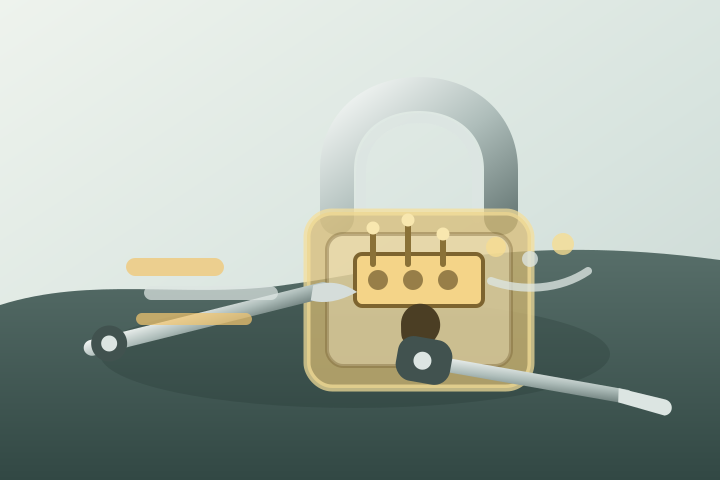
Lockpicking suits patient people who like mechanical puzzles, tactile feedback, careful hand control, and learning how everyday objects work. It is a quiet, tabletop activity: you sit at a desk, hold a small metal pick in one hand and a tension tool in the other, and work a lock open pin by pin until the plug turns. The appeal is the feel — reading subtle spring pressure through your fingertips — and the satisfaction of understanding exactly why a lock opens.
It is best approached as a lawful practice hobby, not as a way to open anything you do not own or have clear permission to study. That boundary is not a formality: in several jurisdictions, carrying lock-opening tools outside your home can itself be a criminal offence, so the legal side comes before the tools (see Legal and Ethical Boundaries).
What You’re Actually Doing
Most everyday padlocks and door cylinders use a pin tumbler mechanism, and that is what you will be practising on. Inside the lock body is a rotating plug (the part the key turns) surrounded by a fixed housing. A row of small holes, the pin stacks, runs through both. Each stack holds two pins — a lower key pin and an upper driver pin — pushed down by a spring.
The boundary between the plug and the housing is the shear line. The lock only opens when the plug can rotate, and the plug can only rotate when every pin stack is lifted so that the gap between its key pin and driver pin lines up exactly with the shear line. The correct key does this by pushing each key pin up to the right height.
Picking reproduces the key by hand. You insert a thin pick into the keyway and lift each pin stack until the driver pin sits just above the shear line — the pin “sets” with a faint click or a sudden loss of resistance. At the same time you apply a light turning force with a tension wrench. When every pin is set, the plug rotates and the lock opens. The skill is feeling, through the pick, which pin is binding, how far to lift it, and how much tension is too much.
Key Terms
- Keyway — the slot the key (and your pick) enters.
- Plug — the rotating core of the lock; the part that turns to open it.
- Housing — the fixed outer body the plug sits inside.
- Pin stack — one column of pins; a typical practice lock has five.
- Key pin — the lower pin, shaped by the key’s cuts.
- Driver pin — the upper pin, pushed down by a spring.
- Shear line — the boundary between plug and housing; pins must align here for the plug to turn.
- Tension — the light turning force applied with a tension wrench.
- Single pin picking (SPP) — setting the pins one at a time; the foundational technique.
- Raking — sweeping a pick through the keyway under tension to set pins by chance; faster but less reliable.
- Security pin — a shaped pin (spool, serrated) that gives a false “set” feeling to slow pickers down.
- Bump key — a specially cut key used with a sharp tap to drive the pins; more associated with forced entry than with hobby practice.
- Decoding — measuring a key’s cuts to work out the pin positions.
Getting Started
Start with the ethics and local rules before buying tools. Practise only on locks you own, purpose-built training locks, or locks where you have explicit permission. Avoid locks in active use, even if they are yours, because practice can damage springs, pins, keys, or the lock body — and a lock you still need to work is not a good practice target.
The smallest sensible first project is a single transparent practice lock and a basic pick set. A transparent lock lets you watch the pins lift to the shear line while you develop the feel, which is the fastest way to connect what your fingers report with what is actually happening. Once the mechanism is clear, move to an opaque practice lock so you have to rely on touch alone.
Legal and Ethical Boundaries
The single most important rule is permission: only pick locks you own or have clear, ideally written, permission to study. Beyond that, the law matters, and it varies by place.
In England and Wales, the Theft Act 1968, section 25 (“going equipped for stealing, etc.”) makes it an offence to have with you, when not at your place of abode, any article for use in the course of or in connection with burglary or theft. Carrying a pick set out with the intent to use it on a lock you have no right to open can therefore be a criminal offence, even if you never use it; the maximum penalty on indictment is three years’ imprisonment. Keeping practice tools at home and using them on your own locks is a different matter, but the line is drawn by intent and by where you are, so it is worth understanding before you carry tools in a bag or on your person.
In the United States and elsewhere, the rules differ state by state and country by country. Some US states restrict possession of lock-picking tools, particularly when carried outside the home or without a locksmith licence or a clear lawful purpose; others do not. Because these laws vary and change, check your own state, province, or local rules before buying or carrying tools, and treat any online summary as a starting point rather than legal advice. This page is not legal advice.
Basic Gear
Essential to start:
- A transparent practice lock (or a cheap, replaceable padlock) so you can see the pins while you learn.
- A small basic pick set — a few pick shapes plus one or two tension wrenches — from a reputable supplier. You do not need a large roll; three or four picks and a tension wrench cover the fundamentals.
- A smooth table, desk mat, or tray to stop tiny parts rolling away.
- Good lighting, and a notebook for recording what each lock feels like.
Optional, once you know you enjoy it:
- Opaque practice locks and progressively pinned trainers (a mix of normal and security pins) to add difficulty.
- A lock vise to hold a lock steady while you work.
- A pinning kit (spare pins and springs) if you want to re-pin and rebuild practice locks.
- Cutaway locks, a storage case, and books or courses on lock structure.
First Session
Set one transparent practice lock on a mat at a desk. Hold the tension wrench lightly in one hand and a pick in the other, and get used to the feel before you try to open anything.
Then work the lock with single pin picking:
- Apply a light, steady turning force with the tension wrench — just enough that the plug wants to turn but does not.
- Insert the pick and find the first pin. Lift it gently until you feel or see it reach the shear line and “set” (a faint click, or the pin dropping slightly).
- Hold that tension and move to the next pin. Repeat until every pin is set and the plug turns.
- If a pin will not set, you are usually applying too much tension and the pin has “locked out.” Ease off, let the pin drop, and try again with less force.
Keep the session short — fifteen to thirty minutes is plenty — so hand tension does not creep in and you do not bend a tool or force a part. Finishing one lock cleanly, and returning it to its starting state, is a better first session than struggling with three.
First Month
Use the first month to build consistency rather than chasing harder locks. Work a small set of legal practice locks, compare how different keyways feel, and keep notes on tension, tool choice, and which pins bind first. Move from transparent locks to opaque ones once you can set pins by sight, so the touch becomes reliable on its own.
Add difficulty slowly: try a lock with a security pin or two, practise raking as a contrast to single pin picking, and — if you enjoy it — start re-pinning a practice lock so you understand what you are picking. A realistic first-month goal is to open a basic five-pin practice lock by touch, consistently, without damaging it.
Costs
Lockpicking has a modest starting cost. A basic pick set and a few practice locks are enough at first — typically on the order of £10–30 / $10–30 for a starter pick set and £3–15 / $3–15 per practice lock, though prices vary by supplier, region, and currency, so check current prices before buying. Costs rise later with higher-quality tools, specialty picks, pinning kits, cutaway locks, a vise, storage cases, books, and club events. You can also keep costs near zero by practising on locks you already own and no longer need, or on inexpensive spare cylinders.
Space Needed
The hobby needs very little room. A desk, tray, or small work mat is enough for practice, and the gear fits in a pouch. If you start re-pinning locks, leave space for tiny springs and pins, because they are easy to lose — a shallow tray or a magnetic mat helps.
Solo or Social
Most practice is solo, and that is a genuine strength: you can practise anywhere you have a desk and your own locks. But the community side adds structure and keeps the hobby honest. Lock sport is the organised, competitive form — timed events where participants open a set of legal practice locks, judged on speed and on not damaging the locks. Clubs, maker spaces, and online communities are useful for learning legal boundaries, tool care, lock identification, and good practice habits, and for getting feedback on your technique. A responsible community is especially valuable for a hobby where the line between lawful practice and misuse is the whole point.
Common Mistakes
- Practising on locks that are installed, in active use, or not clearly yours.
- Ignoring local laws about tool possession, transport, or intent — especially carrying tools outside your home.
- Using too much tension, which locks out pins and can damage tools or locks.
- Buying a large tool roll before learning what the basic tools feel like.
- Skipping notes and repeating the same frustration every session.
- Treating the hobby as a shortcut around permission.
Safety / Accessibility
Legal and ethical risk matters as much as physical safety. Keep tools stored responsibly, transport them only where lawful, and be clear about permission. Physically, the activity is low-risk but repetitive: take breaks if your fingers, wrists, shoulders, or neck ache, and keep your posture neutral at the desk.
A lock vise, larger-handled tools, brighter lighting, magnification, and shorter sessions can make practice more accessible for people with limited grip strength, dexterity, or vision. The hobby is generally suitable for older teenagers and adults; for younger people, the legal and safety boundaries around tools and permission make adult supervision and a clear “own locks only” rule important.
References
Last reviewed: 17 August 2026.
This guide is written for lawful, beginner lockpicking on locks you own or have permission to study. It is not legal advice. Tool-possession and intent laws vary by country, state, and local area and change over time, so confirm your own local rules before buying or carrying tools.
Official legal source:
- Theft Act 1968, section 25 (England and Wales) for the “going equipped for stealing, etc.” offence — having an article for use in burglary or theft when not at your place of abode, the intent requirement, and the three-year maximum penalty on indictment.
Community resources (optional):
- Lockpicking UK for community discussion, legal-boundary guidance, and practice — treat advice as practical context, not legal authority.
Where It Can Go
Lockpicking can lead toward lock sport and timed competition, locksmithing study, physical security research, maker projects, puzzle and lock collecting, safe lock handling, tool maintenance, miniature machining, or volunteer repair work where permission and training are clear. The mechanical curiosity it builds transfers well to electronics, horology, and any hands-on work with small precision parts.
Related Hobbies
Cardistry, chess, electronics, model making, metal detecting, puzzle boxes, woodworking, journaling, and robotics all connect through patience, pattern recognition, hand control, or mechanical curiosity.