Who It Suits
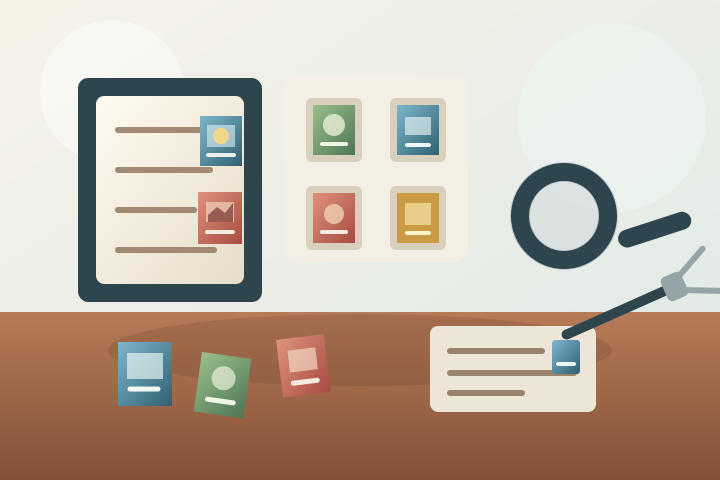
Stamp collecting — the study and gathering of postage stamps and postal material, known as philately — suits people who enjoy small details, history, geography, design, and building an organised collection over time. A beginner’s first sessions look less like treasure hunting and more like sorting and note-taking: separating saved stamps by country, date, and subject, looking up what each one is, and recording what you find.
It works well if you like researching where objects came from, comparing condition, and finding stories in ordinary mail. The honest appeal is that it is quiet, cheap to start, and can be done at a desk; the American Philatelic Society notes that it suits nearly all ages, and some people begin as young as four. The honest constraints are that identification and judging condition take practice, the market can be confusing for newcomers, and value is not the same as interest — a stamp’s appeal lies in its design, history, and story, and most everyday stamps are worth very little money.
Getting Started
Start with stamps you already have before buying anything. Save interesting envelopes, ask family for old letters or travel postcards, and sort stamps by country, topic, age, colour, or design. Choose one simple theme such as your own country, animals, transport, monarchs, space, art, or used stamps from everyday mail.
Two common ways to organise a collection are by country (one section per country, usually in date order) and by theme, or “topical” subject (animals, ships, sport, space). A good first goal is a small set of your own country’s current stamps — one of each denomination on sale at the post office — because it is finite, inexpensive, and teaches you how definitives (the everyday stamps printed in large quantities for indefinite periods) differ from commemoratives (larger stamps issued for a limited time to mark events or anniversaries).
Decide early whether you want loose stamps or covers. A cover is an envelope that actually carried mail, and keeping the stamp on the envelope preserves the postmark, routing marks, and the story of the journey. Collecting covers and postal history is a different, deeper path from collecting loose stamps, and both are legitimate ways in.
Basic Gear
Essential:
- A small group of stamps or envelopes to study (saved mail is enough).
- Stamp tongs with smooth, flat tips, so you handle stamps without touching the printed surface.
- A stockbook, album, or acid-free storage pages.
- A notebook or spreadsheet for country, date, theme, condition, source, and cost.
- A basic stamp catalogue, guidebook, or reputable online reference.
Useful as you go:
- A magnifier or loupe for reading fine print, perforations, and watermarks.
- A perforation gauge, a small ruler-like tool that counts the perforation holes per 2 cm and helps identify stamps.
- Glassine envelopes for temporary sorting.
- A light table or a bottle of watermark fluid for checking watermarks, the faint designs built into stamp paper as a security feature.
First Session
Pick ten stamps and identify as much as you can without rushing. For each, record the country, the denomination (the amount of postage it pays), the subject, and whether it is mint or used. A mint stamp is unused, with its original gum and no hinge; a used stamp carries a cancellation, the mark the post office applies to prevent reuse. Look at the edges for torn perforations, check the surface for thins or repairs, and note whether the design is well centered.
Learn to check for a watermark: hold the stamp up to a bright light, or place it on a light table, and look for a faint design in the paper. Watermarks were built into the paper to make counterfeiting harder, and their presence or absence helps with identification. Handle stamps gently by the edges or with tongs, and never clean a stamp — washing or rubbing removes original gum and surface, and collectors value original condition.
First Month
Use the first month to build a small, neat starter collection rather than buying a large mixed lot immediately. Learn how to remove common modern stamps from paper: soak the paper in lukewarm water for a few minutes until it softens, lift the stamp off, and dry it flat between sheets of blotting paper. If a cover looks interesting — an unusual postmark, a route, a story — keep the whole envelope instead of soaking the stamp off.
Practise sorting, compare catalogue notes with real examples, and learn the vocabulary collectors use: definitive, commemorative, mint, hinged, overprint, first-day cover, and thematic. Decide whether you prefer loose stamps, covers, postal history, or a themed collection, and buy slowly — inexpensive mixed lots, often called kiloware, are a cheap way to practise identification.
Costs
Stamp collecting can start almost free with saved mail, family collections, swaps, and inexpensive mixed lots. A sheet of current stamps from your own country is a small one-time cost at any post office. Costs rise with rare issues, mint condition stamps, specialised albums, reference catalogues, expert certificates, auction fees, postal history, and buying before you understand condition or common reprints.
Space Needed
The hobby needs very little space. A beginner collection can fit in one stockbook, binder, or small storage box. The main requirement is dry, stable storage away from direct sun, damp, adhesives, food, pets, and rough handling that can crease or thin paper. Store stamps in acid-free pages, stockbooks, or glassine envelopes rather than ordinary tape, glue, or PVC plastics, which can discolor and damage paper over time.
Solo or Social
Stamp collecting is easy to do alone, but it becomes more social through stamp clubs, shows, dealers, online forums, swap groups, auctions, and local history groups. Experienced collectors can help identify countries, explain catalogue numbers, and spot damaged, altered, or overvalued material.
If you want a structured next step, the American Philatelic Society (founded 1886) maintains an online dealer directory, stamp club directory, and show calendar, and hosts the Great American Stamp Show. Its research library holds more than 23,000 book titles and 5,700 journal titles. In the UK, the Royal Philatelic Society London’s library is one of the largest philatelic collections in the world, with around 900,000 catalogue entries, and the Smithsonian’s National Postal Museum contributes a major public collection of stamps and postal history to the same union catalogue.
Common Mistakes
- Pulling stamps off envelopes instead of soaking or preserving the full cover.
- Handling stamps with sticky fingers or sharp tweezers.
- Washing or “cleaning” stamps, which removes original gum and surface.
- Hinging valuable mint stamps, which leaves a visible trace on the back.
- Buying large lots before knowing what you want to collect.
- Assuming old automatically means rare or valuable.
- Ignoring tears, thins, missing perforations, heavy hinges, and faded colours.
- Storing stamps in damp rooms, ordinary tape, glue, or PVC plastic sleeves.
- Paying a premium on a seller’s claim of rarity without checking recent sold examples.
Safety / Accessibility
Be cautious with pressure sales, counterfeit overprints, altered cancellations, and claims that a common stamp is rare. Fakes and altered stamps do exist: The Philatelic Foundation in New York maintains a public “Fakes and Forgeries” resource and expertizes stamps and covers for a fee, and the American Philatelic Society operates its own APEX authentication service. Keep purchase records for higher-value items, use reputable sellers when spending more, and be aware that stolen stamps are a known problem — the APS publishes guidance for collectors who inherit a collection or suspect theft.
For accessibility: large-print catalogues, digital magnifiers, stockbooks with dark pages, good lighting, and pre-labelled dividers can make sorting and identification easier.
Where It Can Go
Stamp collecting can lead toward philately, postal history, local history, world geography, design history, first-day covers, postcard collecting, cancellation studies, exhibition displays, auction research, museum volunteering, or a specialised collection around a country, time period, printer, topic, or route.
References
Last reviewed: 18 August 2026.
Background (authoritative):
- American Philatelic Society, Getting Started — the APS’s beginner entry point: what stamp collecting involves, who collects, and links to the full beginner series.
- American Philatelic Society, Stamp Vocabulary — plain-English definitions of the terms collectors use, from cancellation and cover to watermark and overprint.
- American Philatelic Society, Where to Get Stamps? — practical sources for beginner stamps, with links to the APS dealer directory, club directory, and show calendar.
- American Philatelic Society, Learn — the beginner hub covering soaking, sorting, storing, identifying, and tools, plus the APS research library.
Expertizing and consumer protection (official):
- The Philatelic Foundation — New York expertizing service with a public “Fakes and Forgeries” education section, a searchable certificate archive, and guidance on when to re-certify older material.
Research libraries (optional):
- Global Philatelic Library — a consolidated listing of philatelic publications and archives held by libraries worldwide, including the Royal Philatelic Society London (around 900,000 entries), the American Philatelic Research Library, and the Smithsonian’s National Postal Museum.
Related Hobbies
Coin collecting, genealogy, journaling, scrapbooking, photography, model making, calligraphy, travel, and local history research all pair naturally with stamp collecting.