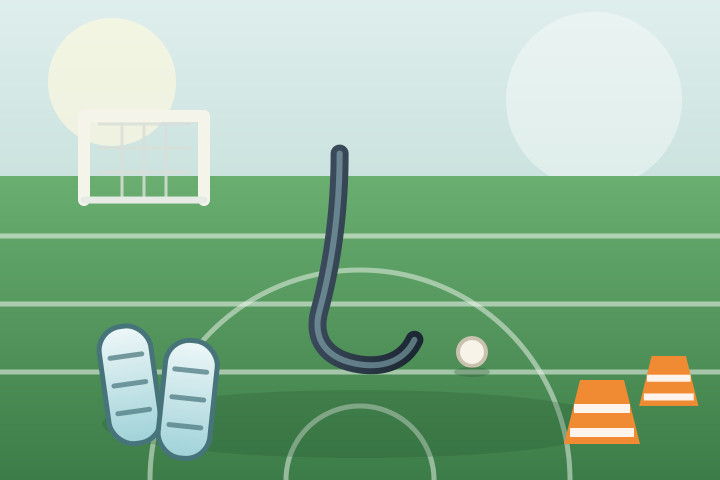
Who It Suits
Field hockey is a team sport in which two sides of seven players use a curved stick to pass, dribble, and shoot a small hard ball into a goal. Matches are played on artificial turf or grass, and the ball moves fast: a good hit can travel the length of the field, and a well-timed drag flick can curl over a goalkeeper. The stick is the central tool, and most of the learning is about keeping the ball close, passing it cleanly, and reading where your teammates and defenders are moving.
A beginner’s first sessions are much smaller than a full match. You will spend most of your time learning to hold the stick, push the ball along the ground, make soft short passes with a partner, and defend by sweeping the ball away - usually at a club, school team, or community group before joining a full game.
It suits people who like running, hand-eye coordination, quick decisions, and learning a physical skill in layers. The realistic constraints are that it is a team sport (you need other players and a field), the stick skills take genuine practice to feel natural, and the basic kit - stick, shin guards, and boots - is a moderate first investment.
This guide is written for beginners deciding whether field hockey fits their budget, fitness, local access, and social comfort. Cost and difficulty estimates assume casual club or community entry rather than competitive leagues.
Key Terms
A few words do most of the work in field hockey coaching and club conversation:
- Stick — a curved stick, about 36 inches (91 cm) long, with a flat blade at the bottom. Only the flat side may be used on the ball.
- Ball — a small, hard, usually white ball, lighter than a soccer ball but hit much harder.
- Shooting circle — the semicircle in front of the goal. Goals only count if the ball is hit from inside it.
- D — the small semicircle in front of the shooting circle, where the goalkeeper may play.
- Corner (penalty corner) — a set piece awarded when the defending team last touches the ball on the goal line; the attacking team takes a short pass into the circle.
- Penalty stroke — a one-on-one shot from 7 metres out, awarded for fouls inside the D.
- Penalty corner vs penalty stroke — the corner is a chance to work the ball in; the stroke is a guaranteed shot on goal.
- Drag flick — a shot where the ball is dragged along the ground and flicked up and over the goalkeeper, usually from a corner.
- Hit — a long, powerful shot where the ball is lifted off the ground with the stick.
- Push pass — a short, controlled pass made by pushing the ball along the ground.
- Sweep — a defensive move that clears the ball away from an attacker.
- High stick — a foul where the stick or ball is raised dangerously high; a common beginner warning.
- Backstick — using the curved (back) side of the stick on the ball, which is not allowed.
- Rolling substitution — swapping players in and out during play, which keeps the game flowing.
- FIH — the International Hockey Federation, the world governing body that sets the rules and runs the World Cup.
Getting Started
Start with a club, school team, university group, or community “learn to play” session - not with a stick. Most clubs provide loaner sticks and balls for beginners, and introductory sessions are typically low-cost, so you can try the sport before spending anything. A good beginner session will cover how to hold the stick, push and receive the ball, keep it low, and defend with a sweep.
Find your nearest club through your national governing body - for example, Field Hockey Canada, Hockey Australia, England Hockey, or USA Field Hockey - each of which publishes participation or club information. The FIH lists its member associations if you are looking elsewhere.
Most beginners should join whatever group is available nearby rather than waiting for the perfect team. Men’s, women’s, and mixed recreational groups all teach the same fundamentals, and many clubs run beginner-friendly nights specifically for new players.
What To Do This Week
- Find two nearby clubs, schools, or university hockey groups that run beginner or open sessions.
- Ask what the first session includes, whether sticks and balls are provided, and what membership costs after the taster.
- Book a taster or beginner session rather than buying a stick.
- Wear comfortable sports clothing and proper field hockey boots or firm-soled shoes; no cleats that damage turf.
- Start a simple notes file for stick-handling cues, set-piece names, and questions for the coach.
- After the session, write down whether you enjoyed the rhythm of moving, passing, and reading the field.
Questions To Ask a Club
| Question | Why it matters |
|---|---|
| Do you provide beginner sticks and balls? | You should not need to buy a stick before learning. |
| What does membership cost after the taster? | Ongoing club fees matter more than first-session price. |
| When are beginners allowed to join full games? | You need to know the safety level expected before playing with the whole club. |
| Do you run youth, adult, or beginner classes? | Age groups and pace differ, and the right group affects whether you keep going. |
| What boots or shoes are required? | Turf, grass, and indoor surfaces need different footwear. |
| Can you adapt practice for injuries or mobility limits? | Many clubs can, but it is easier to arrange before you start. |
Basic Gear
For your first sessions you only need:
- Comfortable sports clothing.
- Field hockey boots (turf or grass) or firm-soled indoor shoes.
- Shin guards - the one piece of protective gear every player wears.
- Water bottle.
- Notebook for stick-handling cues, set-piece names, and questions.
Everything else - your own stick, mouthguard, gloves, and goalkeeper kit - can wait. A beginner stick is the main early purchase, and many clubs let you borrow one while you learn. Buy your own stick only after you know your playing style and the club’s requirements; second-hand sticks are common and can cut costs.
| Item | What it does | Beginner note |
|---|---|---|
| Stick | Passes, dribbles, shoots, and defends | Borrow first; buy a general-purpose stick once you commit |
| Shin guards | Protect the shins from hard balls and sticks | Wear them from the first session |
| Mouthguard | Protects teeth from accidental contact | Recommended, and required in some competitions |
| Boots | Grip and control on turf or grass | Match the surface your club plays on |
| Gloves | Protect the hands, especially for goalkeepers | Optional for field players |
First Session
Expect the first session to run roughly like this: arrive 10-15 minutes early and check in, the coach fits you with a loaner stick and covers safety basics (keep the stick low, no backstick, watch your teammates), then warm-ups, stick-handling drills, short partner passing, and a small-sided game, with a wrap-up on what comes next. Tell the coach about injuries, previous sports experience, or whether you are left-handed - field hockey sticks are right-handed only, so left-handed players learn to play right-handed, and a good coach will set that up properly.
The first session can feel awkward because the stick, the ball, and the pace are all unfamiliar. That is normal. The useful question is whether you enjoy the rhythm of moving, passing, and reading the field.
First Month
Train once or twice a week while your legs, hands, and stick-handling adapt. A realistic first-month sequence looks like:
- Weeks 1-2: holding the stick, pushing the ball along the ground, receiving a soft pass, and keeping the stick low; basic sweeping to defend.
- Weeks 3-4: short push passes with a partner, dribbling through cones, and your first controlled hits; learning the shape of the shooting circle and where to stand.
- Ongoing: small-sided games at a pace the coach sets, learning the set pieces (corners, penalty strokes) and how to move with the ball.
Ask when beginners are allowed to join full games and what safety level is expected. Keep early games slow enough to learn. Good progress means cleaner passing, better ball control, fewer high sticks, and more deliberate movement.
Costs
Field hockey has moderate costs, and the structure matters more than any single number:
- Trying it out: introductory and taster sessions are typically low-cost, and most clubs provide loaner sticks and balls while you try it out.
- Ongoing club play: membership and pitch fees, which vary widely by country, city, and club.
- Personal kit: a stick, shin guards, and boots when you commit; second-hand kit is common and can cut costs.
- Competition (optional): national membership, entry fees, travel, and sometimes goalkeeper kit.
Private lessons and competition travel raise the budget; recreational club hockey can stay much simpler. Ask your club for a full cost breakdown (membership, pitch fees, kit, competition) before you commit - it varies enough by place that only the club can give you a real number.
Space Needed
Field hockey needs a club, school, or community field - artificial turf or grass - with goals and safe supervision. At home, you only need a small clear area for stick-handling drills, passing against a wall, and notes. Do not practise hits near people, pets, or anything breakable, and do not use a hockey stick on a hard surface where the ball can rebound unpredictably. The field is the heart of the hobby: the ball is hit hard and travels fast, so open, marked space is what makes the sport safe and fun.
Solo or Social
Field hockey is strongly social because teammates, coaches, and club culture shape the hobby. Solo stick-handling and wall passing are useful, but you need other players to learn timing, movement, set pieces, and game awareness.
Clubs often suit a wide range of personalities: some people enjoy structured training, some enjoy the flow of a full match, and others get involved through coaching, refereeing, keeping score, or running the club.
Common Mistakes
- Buying a stick before knowing your club’s requirements and your own playing style.
- Hitting the ball with the back of the stick, which is not allowed and feels wrong.
- Raising the stick high, which is a foul and a safety risk.
- Stepping on the ball, which is a foul and stops play.
- Chasing the ball instead of moving with your teammates.
- Treating every beginner game like a competition.
- Ignoring warm-ups, shin comfort, and recovery.
Safety / Accessibility
Field hockey uses a hard ball and a stick, so the safety system has several layers: shin guards for every player, a mouthguard for everyone, the coach’s stop commands, and a controlled pace in beginner games. Keep your stick low, watch your teammates, and follow the coach’s commands. Bruises, shin soreness, and hand fatigue are common in the first weeks and settle as your technique improves.
Field hockey is also one of the more accessible team sports:
- Age range is wide: clubs run youth, adult, and veteran programmes, and there is no upper age limit.
- Adaptations such as lighter drills, smaller-sided games, extra rest, or a non-competitive route are often possible; ask before joining if you need mobility adjustments.
- Glasses are usually not a barrier - many players wear them, and goalkeepers use protective masks.
- Wheelchair and seated hockey exist as adapted formats in some regions, where the same stick skills are played from a seated position.
Where It Can Go
Field hockey can lead toward recreational club nights, school and university teams, adult leagues, small-sided games, coaching, refereeing, goalkeeper training, strength and conditioning, or cross-training with running, soccer, or other field sports.
References
Last reviewed: 18 August 2026.
This guide is written for beginner club field hockey. It is not a substitute for coaching, and equipment decisions should follow your club’s and federation’s safety requirements. Club fees, kit prices, and programme availability vary by country and club, so confirm local costs and access directly.
Official sources:
- FIH — the International Hockey Federation, the world governing body that sets the rules, runs the World Cup, and lists its member associations.
- Field Hockey Canada — the Canadian governing body for field hockey; publishes programme, competition, and governance information.
- Hockey Australia — the Australian governing body; publishes rules and a club finder for Australia.
- England Hockey — the national governing body for field hockey in England; publishes participation, club, and officiating information.
- USA Field Hockey — the United States national governing body for field hockey; publishes rules, programmes, and ways to play.
Local clubs, certified coaches, and recreation departments remain the best sources for kit lists, league fees, and home-practice decisions.
Related Hobbies
Lacrosse, soccer, hockey, rugby, field sports, running, strength training, and other team games all sit nearby.