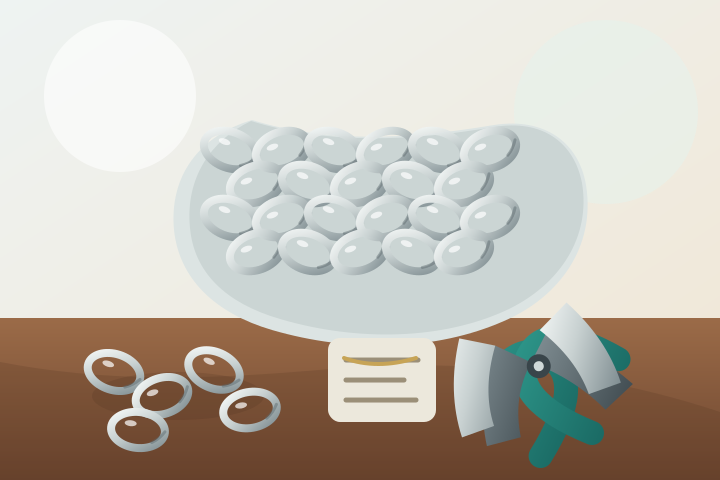
Who It Suits
Chainmail making suits people who like precise handwork, repeating patterns, metal textures, and projects that grow one small connection at a time. It works well if you enjoy puzzles, jewellery, historical craft, fantasy costuming, or portable making sessions that do not need a large workshop.
What you actually do: open small metal rings with two pliers, thread them through each other in a repeating pattern, and close each ring flush until the work hangs as a flexible sheet. The appeal is concrete: the work is portable, progress is visible ring by ring, and the same basic motion builds everything from a keychain to a full historical shirt. The honest constraints: it is slow (a full shirt is tens of thousands of rings), it tires hands and wrists, and loose rings are a choking hazard around young children.
Getting Started
Two names for the same craft: “chainmail” is the historical English term, while modern makers usually say “maille” (from French). The standard beginner weave is European 4-in-1: each new ring passes through four rings of the previous row, and rows alternate direction.
Start with pre-cut jump rings, two pairs of smooth-jaw pliers, and one beginner weave such as European 4-in-1. A kit can be useful because the ring size, wire gauge, and project instructions are already matched, which removes a lot of early guesswork. If you buy rings separately, check the aspect ratio — the ring’s inner diameter divided by its wire diameter — because each weave wants a particular range. European 4-in-1 can be made at an aspect ratio of about 3 or higher; a ratio around 4 is a common practical starting point, while larger ratios produce a looser sheet. Follow the pattern or supplier’s stated ring size for the specific project.
Metals matter more than tools for a first project:
- Anodized aluminium is light, cheap, and easy to open, but the coloured coating can wear off with handling.
- Copper is soft and forgiving, but tarnishes and needs polishing.
- Stainless steel is durable and the usual armour metal, but it is harder on pliers and hands, so it is a better second metal than a first one.
Basic Gear
- Two pairs of flat-nose, chain-nose, or bent-nose pliers (you hold one in each hand).
- Pre-cut jump rings in a beginner-friendly size.
- A small tray, mat, or towel to stop rings from rolling away.
- Containers for open rings, closed rings, and finished sections.
- Pattern instructions or a weave diagram.
- Good lighting and optional magnification.
- Clasps, key rings, cord, scales, beads, or findings for finished pieces.
- A notebook for ring counts and notes on what worked.
First Session
Use the first session to learn how to open and close rings cleanly. Twist each ring sideways rather than pulling it apart, and aim for closures that meet flush without gaps or overlap. Then make a small strip, bracelet, keychain, or sample square so you can see how the weave hangs and where mistakes appear.
A good first project is a small European 4-in-1 square, for example ten rows of ten rings. It teaches the two skills every maille project needs: keeping rows even, and working in the correct direction — each row starts where the previous row ended, and the pattern only holds if you keep track of which side is “up”. Count your rings as you go; a missing ring shows up as a gap a row later.
First Month
Spend the first month repeating a few small projects instead of jumping straight to a shirt or large costume piece. Practice ring control, tension, rhythm, and reading the direction of the weave. The vocabulary that does most of the work:
- Weave — the repeating pattern, named for how many rings each ring passes through (European 4-in-1, Byzantine, Persian, Japanese 6-in-2).
- Aspect ratio — a ring’s inner diameter divided by its wire diameter; it determines whether a weave will close and how tight or loose the finished sheet will be.
- Gauge — a numbered wire-size system in which a higher number usually means thinner wire. American Wire Gauge (AWG) and Standard Wire Gauge (SWG) are not identical, so a supplier should state the system and preferably the diameter in millimetres or inches.
- Even and odd rows — the alternating directions of a weave; losing track of them is the most common beginner error.
Try a second pattern such as Byzantine, box chain, half Persian, or Japanese 12-in-2 once European 4-in-1 feels natural.
Costs
Chainmail making can start cheaply because the core setup is only rings, pliers, and a simple workspace. A beginner kit typically runs roughly US$20–50, and a basic pair of pliers US$10–30; prices vary by region and retailer, so treat these as planning figures. Costs rise with stainless steel, titanium, anodized aluminium, precious-metal rings, specialty pliers, scales, clasps, tumbling supplies, storage boxes, and the very large ring counts needed for armour-sized projects: a full European 4-in-1 shirt uses on the order of 20,000–30,000 rings, so the rings alone can cost several hundred to over a thousand dollars depending on the metal.
Lower-cost routes: start with anodized aluminium or copper for practice pieces, buy rings by the small pack rather than by the kilo, and use kits for the first few projects.
Space Needed
Small jewellery and sample projects need very little space: a desk, tray, lap board, or craft mat is enough. Larger sheets need more sorting space because thousands of rings can become hard to manage if open, closed, and finished sections are mixed together.
Solo or Social
Chainmail making is easy to do solo while listening to music, watching a show, or working through a pattern at your own pace. It can also be social through craft groups, renaissance fairs, cosplay communities, historical reenactment groups, armourers’ forums, jewellery classes, and online weave-along projects. If you are drawn to the armour side, the Society for Creative Anachronism (SCA) is a large international organization whose members build and wear real armour for staged combat; its marshals check that armour meets published construction standards, and local groups often welcome newcomers who want to learn the craft.
Common Mistakes
- Buying rings without checking that the aspect ratio matches the weave.
- Pulling rings open instead of twisting them sideways.
- Leaving closures sharp, gapped, or overlapped.
- Starting with hard stainless steel before learning on easier metals.
- Mixing ring sizes by accident and wondering why the pattern distorts.
- Losing track of row direction, or miscounting rings and getting a gap a row later.
- Beginning an armour-scale project before finishing several smaller pieces.
Safety / Accessibility
Hand fatigue, wrist strain, sharp ring ends, tiny loose parts, eye strain, and metal sensitivities are the main concerns.
- Small parts — loose rings are a choking hazard for children under three; keep them in a closed tray and clear the bench at the end of a session.
- Repetitive strain — the same twist-and-close motion for an hour or more tires hands and wrists; take breaks, keep pliers comfortable, and stop before your grip gets sloppy.
- Sharp ends — a poorly closed ring can poke; check closures on anything you will wear, and if you cut your own rings with flush cutters, wear eye protection and aim cut ends into a container.
- Metal sensitivities — some stainless steels contain nickel, a common contact allergen; if you have a known sensitivity, choose nickel-free or hypoallergenic metals for jewellery and check the supplier’s alloy information.
Larger rings, softer metals, ergonomic grips, magnification, bright task lighting, and short sessions can make the hobby easier to manage.
Where It Can Go
Chainmail making can lead toward jewellery, costume armour, cosplay accessories, historical reproduction, sculpture, inlay patterns, scale mail, bags, lampshades, clothing accents, dice bags, ornaments, teaching, repair work, or small-batch selling. The paths differ in commitment: a dice bag or bracelet is a weekend-scale project; a full shirt is a months-long build measured in tens of thousands of rings; and staged-combat armour, such as SCA combat mail, must meet the construction rules of the organization that fields it, which set requirements on ring material, size, and closure.
References
Last reviewed: 17 August 2026.
Official and organizational sources:
- Society for Creative Anachronism: Armored Combat — the SCA’s official page on staged armored combat: real armour, rattan weapons, marshal safety oversight, and authorization for new fighters.
- Society for Creative Anachronism: Martial Activities — lists the Armored Combat Marshals’ Handbook, the SCA’s published rules for armor and weapon construction.
- NHS: Contact dermatitis — official guidance on allergic contact dermatitis, including reactions to metals such as nickel.
Optional community resources:
- Chainmaille.org — community-run maille reference with a weaves database, ring charts, and supplier list.
- Chainmaillers: European 4-in-1 tutorial — a specialist tutorial showing that the weave can be made from an aspect ratio of about 3 upward, with lower ratios producing a tighter sheet.
Related Hobbies
Jewellery making, wire wrapping, blacksmithing, leatherworking, historical reenactment, cosplay, model making, knitting, and crochet all sit nearby because they share pattern reading, hand control, material choice, and patient assembly.