Who It Suits
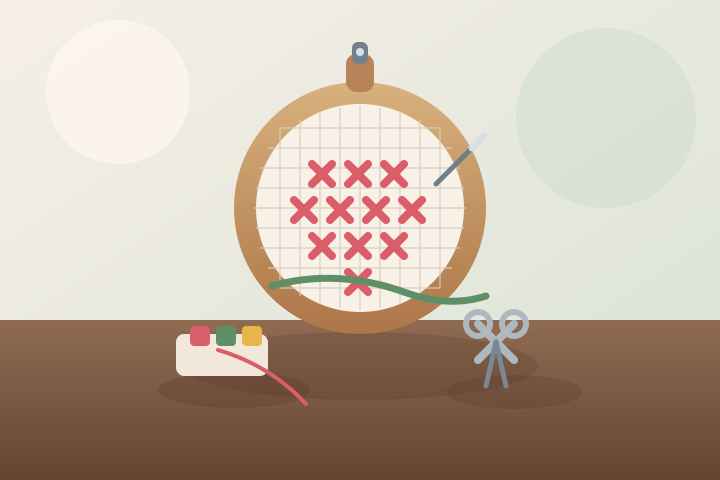
Cross stitch is a counted needlework: you stitch small X-shaped crosses onto even-weave fabric with a visible grid, following a chart that tells you which colour goes on which square. Because every stitch lands on the grid, the work is forgiving — there is no freehand drawing, and the image resolves as you go.
It suits people who enjoy patterns, counted steps, colour blocks, and calm repetition. The honest appeal: it is cheap to start, needs no dedicated space, is easy to pause and resume, and a first small piece can be finished in a few weeks of short sessions. The honest constraints: progress is slow and repetitive, the first rows look uneven, charts use symbols and colour codes that take a little practice to read, and long sessions can tire the eyes, hands, and neck.
Cross stitch has a long history. Samplers — small pieces of cloth stitched by girls to practise stitches and record their learning — were common in Europe and North America from the 16th century onwards, and the Victoria and Albert Museum holds examples of samplers and counted needlework in its collections.
Getting Started
A beginner’s first task is to learn the vocabulary, then make one small piece:
- Full cross stitch — two half stitches forming an X. Keep the direction of the X the same across the whole piece (usually the lower-left to upper-right stroke first).
- Backstitch — a line of small connected stitches used for outlines and lettering; it is added after the main crosses are done.
- French knot — a small coiled knot used for dots and details.
- Count — the number of holes per inch in the fabric. 14-count Aida is the most common beginner fabric; higher counts (16, 18, 20, 22 and finer) give smaller stitches and finer detail.
- Aida cloth — an even-weave fabric with a clearly visible grid, ideal for learning.
- Chart — a grid of symbols, each matching a floss colour listed in a key. Most commercial charts reference DMC floss colour numbers.
- Strands — cotton embroidery floss comes in skeins of six strands; most 14-count Aida patterns call for two.
There are two main traditions. Counted (English) cross stitch follows a chart on even-weave fabric and is the usual starting point. Continental (uncounted) cross stitch is worked freehand, often over a running-stitch base, and is common in folk traditions.
Start with a small beginner kit on 14-count Aida — a heart, a flower, or a sampler square — rather than a large picture. A kit includes fabric, floss, needle, and chart, and keeps the first project small enough to finish.
Basic Gear
Essential:
- Aida cloth (14-count is a good first choice) or a beginner kit.
- Cotton embroidery floss in the pattern colours.
- A blunt-tipped tapestry needle; size 24 is a common match for 14-count Aida. Higher needle-size numbers are finer, with sizes 22, 24, 26, and 28 commonly used for cross stitch.
- A hoop or small frame.
- Small scissors.
- A printed chart or digital pattern.
Optional at first:
- A needle threader.
- A thread organiser or card for keeping colours sorted.
- A hoop stand, if you stitch at a desk.
- A magnifier, if the chart or fabric is hard to see.
First Session
Use the first session to find the centre of the fabric (count squares from the middle), secure it in the hoop so it is taut but not stretched, thread the needle with two strands, and stitch one small colour area. Focus on making each X the same way and the same size, and on keeping the fabric flat — stitches pulled too tight will pucker it.
First Month
During the first month, finish one small kit or sampler. Practice reading chart symbols, changing colours, carrying thread neatly on the back, and adding backstitch outlines only after the main crosses are complete. By the end of the month you should be able to read a chart without constantly checking the key, keep your X direction consistent, and know whether you prefer a hoop or a frame.
Costs
Cross stitch starts cheaply: a small beginner kit — fabric, floss, needle, and chart — is a modest one-off purchase (roughly a few pounds or dollars, depending on where you shop; prices vary by region and change over time, so check current listings before budgeting). Free patterns are widely available online for those who already own a basic floss set. Costs rise when you buy large thread collections, premium fabrics, specialty frames, storage boxes, or professional framing for finished pieces.
Space Needed
Cross stitch needs very little space. A hoop, chart, scissors, and thread organiser fit in a small pouch, which makes the hobby easy to take to a sofa, a library, or a craft group. Larger projects are easier with a lamp, a stand, and a place to keep sorted colours.
Solo or Social
It works well alone, but the hobby has an active community side: local cross stitch guilds and needlework societies run classes, stitch-alongs, and shows; needlework shops often host beginner evenings; and online pattern communities and progress groups make it easy to compare charts and ask questions. The work is easy to pause and resume, which also makes it friendly for relaxed group settings.
Common Mistakes
- Starting with dark fabric or a very large, detailed pattern too early.
- Pulling stitches so tight that the fabric puckers.
- Letting the direction of the X vary across the piece.
- Mixing up similar chart symbols or close floss shades.
- Using too many strands for the fabric count, so stitches sit bulky.
- Letting floss twist until stitches look uneven.
- Forgetting to check the fabric count before choosing a pattern size.
Safety / Accessibility
Eye strain, hand fatigue, needle pricks, and neck posture are the main concerns. Repetitive strain injury (RSI) develops gradually from repeated movement; the NHS advises keeping active, taking breaks, and seeing a GP if pain does not go away or gets worse. In practice: good lighting, shorter sessions, a relaxed grip, a hoop stand, and lower-count, coarser fabric can help. People with limited vision or fine-motor control may find 11- or 14-count Aida, a magnifier, and a needle threader easier to manage than finer fabrics.
Needles are sharp: keep them away from young children, do not carry a threaded needle loose in a bag, and put the needle down when you pause.
Where It Can Go
Most people stay in the casual tier — ornaments, gifts, patches, and framed pictures — and that is a complete hobby in itself. The technical tiers build on the same basic stitches: finer-count work, pattern design, samplers, blackwork, needlepoint, and other counted and freehand embroidery.
References
Last reviewed: 17 August 2026.
Standards and safety:
- NHS, Repetitive strain injury (RSI) — guidance on causes and self-care for hand and wrist strain from repetitive activity.
- DMC: Cross Stitch — a manufacturer introduction to Aida count, blunt tapestry needles, and 14-count Aida as a beginner fabric.
- John James Needles Guide — a needle manufacturer’s guide identifying sizes 22, 24, 26, and 28 as the common tapestry/cross-stitch range.
Background:
- Victoria and Albert Museum collections — search “cross stitch” for samplers and counted needlework in the V&A’s collections.
Related Hobbies
Embroidery, needlepoint, sewing, quilting, knitting, crochet, weaving, calligraphy, and digital illustration all sit nearby because they reward patience, pattern reading, colour choice, and steady handwork.