Who It Suits
Woodturning suits people who enjoy tools, natural materials, and the satisfaction of making a clean shape appear quickly. It is a good fit if you like woodworking, sculpture, practical objects, careful hand control, or projects that move from rough blank to finished piece in a visible way.
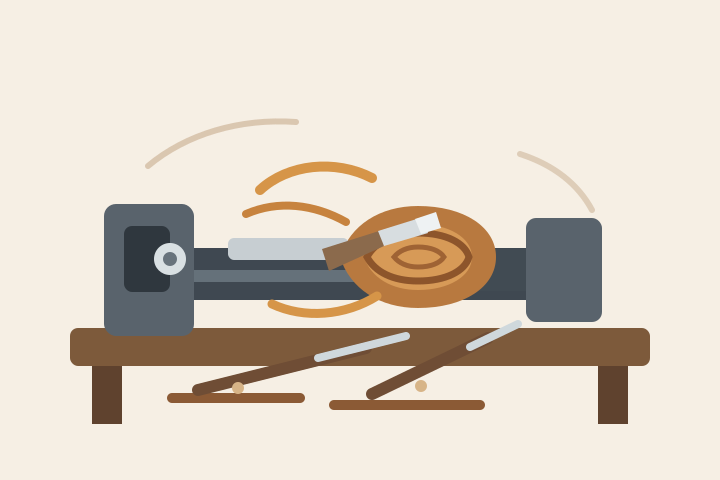
What you actually do: mount a piece of wood (a blank) on a lathe, spin it at speed, and shape it with a hand-held tool that rides on a sliding support. A typical beginner session is mounting a small spindle blank, setting the tool rest, bringing the lathe up to speed, and making a few simple cuts — rounding, a cove, a bead — stopping often to inspect the shape. The appeal is concrete: wood peels away in long curls, and a usable object can appear in a single session. The honest constraints: the workpiece is spinning fast, so a tool or workpiece catch can whip violently — this is a genuinely hazardous hobby and instruction matters. It is also dusty, noisy, and a real investment to start, and the first month is mostly about learning tool control before the projects get interesting.
Getting Started
Start with instruction before buying a lathe. A class, club session, maker space, or supervised workshop will teach stance, tool rest setup, blank mounting, grain direction, and safe speeds much faster than trial and error.
There are two main branches, and beginners should learn the first one before touching the second:
- Spindle turning — the blank is held between two centres (or in a chuck) and turned along its length. Projects include beads, coves, handles, dibbers, pens, and table legs. The work is small, the speeds are forgiving, and the cuts are easy to see.
- Bowl turning — the blank is mounted on a faceplate and turned from the face: the outside is shaped, the piece is flipped, and the inside is hollowed out. Bigger, messier, and more demanding — the work can be heavy and unbalanced, and hollowing is the hardest cut a beginner will make.
A good first project is a small spindle: a dibber, a spoon handle, or a simple bead. It teaches mounting, speed, tool rest position, and a handful of basic cuts in a single object.
Basic Gear
Essentials:
- Wood lathe with an appropriate speed range (a benchtop lathe for small spindle work; a mid-size lathe if you plan to turn bowls).
- Face shield (not just safety glasses) and hearing protection.
- A spindle gouge and a parting tool to start; a bowl gouge and a scraper when you move to bowls.
- A way to hold the work: a chuck or drive centre plus a live centre for spindle work, a faceplate for bowls.
- A sharpening system (grinding wheel or jig) — turning tools are only as good as their edge.
- Straight-grained wood blanks.
- Sandpaper and a simple finish (oil, wax, or varnish).
- Dust collection or a respirator for sanding.
Optional at first: a skew chisel (for fine finishing cuts), extra tools, a dedicated dust collector, and a tool stand.
First Session
Use the first session to learn how the lathe feels rather than trying to make a perfect object:
- Inspect the blank for cracks, splits, or loose knots, and check that it is mounted firmly.
- Set the tool rest close to the work, and rotate the work by hand before powering on.
- Stand out of the line of the work when bringing the lathe up to speed.
- Make a few simple cuts with a sharp tool — rounding, a cove, a bead — stopping the lathe often to inspect the shape.
- Notice how tiny changes in tool angle and pressure change the surface.
A good first session ends with a few clean cuts and an understanding of why the tool rest stays close to the work.
First Month
Spend the first month on small repeatable projects. Make several practice spindles, a few handles, or a batch of pens before attempting a large bowl. Learn sharpening early, because dull tools make turning harder and less safe. Keep notes on wood type, speed, tool choice, sanding grit, and finish so each project teaches the next one.
The vocabulary that does most of the work:
- Blank — the piece of wood you start with, usually bought pre-cut.
- Spindle turning / bowl turning — turning along the length of the work / turning from the face and hollowing it out.
- Tool rest — the sliding support the cutting tool rides on. Keeping it close to the work is the single most important safety habit in turning.
- Gouge — a curved-blade cutting tool. A spindle gouge is for lengthwise work; a bowl gouge is for hollowing.
- Skew — a flat, angled tool for fine finishing cuts.
- Parting tool — a narrow tool for cutting rings and separating pieces.
- Scraper — a tool that pushes rather than cuts; useful on end grain and forgiving for beginners.
- Catch — when the tool or work suddenly grabs and whips. The signature turning danger.
- Chuck / drive centre / live centre / faceplate — the four common ways of holding work: a keyed chuck, a screw-driven centre, a passive centre, and a bolted plate for bowls.
- Green wood — freshly cut, still-wet wood. Turning it is a separate discipline with its own timing and tools.
- Segmented — a piece built from glued-together pieces of wood, often for colour contrast.
- Hollow form — a turned vessel hollowed out of a solid blank, the step beyond a simple bowl.
Costs
Woodturning has a higher starting cost than many crafts, and the honest way to budget is by route (prices vary a lot by region and change over time, so check current listings before budgeting):
- Class or shared-shop route (recommended first): a single beginner class typically costs roughly US$50–200; maker space memberships run roughly US$50–150 per month and include lathes, tools, and dust extraction.
- Benchtop spindle lathe: roughly US$300–800, plus a starter tool set (US$100–300), a chuck or centres, and a sharpening setup (US$100–400).
- Mid-size spindle/bowl lathe: roughly US$800–2,500; a serious bowl lathe starts around US$2,500 and can go well beyond.
Blanks are the ongoing cost: spindle blanks are a few dollars each, bowl blanks more. Lower-cost routes exist: buy used (lathes and tools hold their value and are widely available second-hand), join a club with shared equipment, and start with offcuts.
Space Needed
A benchtop lathe can fit in a corner of a garage, shed, or workshop, but the setup still needs a solid bench, room to stand comfortably, and clear space around the moving parts. Bowl turning and sanding create mess and dust, so ventilation and cleanup matter. Shavings are a useful by-product — they burn well as kindling and are often used as animal bedding — but they still need a bin and regular cleanup.
Solo or Social
Most turning time is solo, but woodturning is strongly supported by clubs, guilds, demonstrations, classes, and shows. Watching an experienced turner sharpen, present a tool, and recover from a catch is especially valuable for beginners. Local clubs run open shop nights and mentoring, and turning shows and fairs are a common place to see work, meet other turners, and buy blanks.
Common Mistakes
- Buying a lathe before understanding tool, chuck, and sharpening costs.
- Turning blanks that are cracked, loose, or poorly mounted.
- Using speeds that are too high for the size or balance of the wood.
- Letting the tool rest sit too far from the work.
- Using a dull tool and pushing harder instead of sharpening.
- Trying bowls before learning basic spindle control.
- Sanding without dust protection.
- Wearing safety glasses instead of a face shield.
Safety / Accessibility
The main risks are flying wood, catches, dust, noise, sharp tools, and loose clothing or hair near rotating work. OSHA notes that woodworking operations are hazardous “particularly when machines are used improperly or without proper safeguards,” and lists laceration, amputation, severed fingers, and blindness among common injuries from woodworking equipment, with wood dust and finishing chemicals as the main health hazards. Its general industry standards require machine guarding (29 CFR 1910.212), eye and face protection against flying particles (29 CFR 1910.133), and hearing protection where noise is high (29 CFR 1910.95).
- Catches — the signature turning danger: the tool or work suddenly grabs and whips. Keep the tool rest close to the work, keep the blank secure and balanced, use a sharp tool, and stand out of the line of fire when bringing the lathe up to speed.
- Dust — fine wood dust is a respiratory irritant, and the International Agency for Research on Cancer classifies wood dust as a human carcinogen, especially from hardwoods. Use dust extraction or a well-ventilated space, wear a respirator when sanding, and vacuum rather than blow dust away.
- Clothing — remove jewellery, secure sleeves and hair, and avoid loose clothing near the work.
- Finishes — solvent-based finishes give off fumes; work in a ventilated space and read the product label.
- Age — a lathe is a serious power machine; this is generally a teen-to-adult activity, and younger participants should only turn with close supervision, instruction, and a suitably small lathe.
A face shield, not just safety glasses, is the standard for turning. Adapted setups can make the hobby more accessible: seated turning, lighter blanks, adjustable benches, and longer tool handles reduce the grip strength and body position demands.
Where It Can Go
Woodturning can lead toward bowl turning, pen making, hollow forms, green wood turning, segmented turning, tool handles, furniture parts, ornaments, vessels, artistic sculpture, or selling small handmade objects.
References
Last reviewed: 17 August 2026.
Official and institutional sources:
- OSHA: Woodworking — the official safety entry point for woodworking hazards.
- OSHA: Woodworking — Hazards and Solutions — common injuries (laceration, amputation, severed fingers, blindness) and health hazards (wood dust, finishing chemicals).
- OSHA 1910.212: General requirements for all machines — machine guarding requirements.
- OSHA 1910.133: Eye and face protection — eye and face protection against flying particles such as chips and shavings.
- OSHA 1910.95: Occupational noise exposure — noise-exposure limits and hearing-conservation requirements.
Community resources (optional):
- The Woodworkers Institute — projects, techniques, and tool guidance from a long-running woodworking publication, including its Woodturning magazine.
Related Hobbies
Woodworking, wood carving, wood burning, blacksmithing, pottery, model making, and jewellery making all sit nearby — they share tool skill, material awareness, and finishing work.