Who It Suits
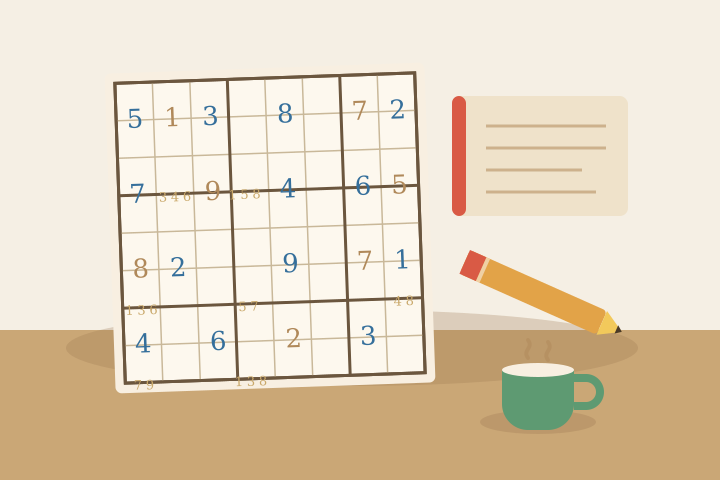
Sudoku is a logic puzzle played on a 9×9 grid, divided into nine 3×3 boxes. Some cells start out filled with digits, and the goal is to fill every empty cell so that each row, each column, and each 3×3 box contains the digits 1 through 9 exactly once. There is no arithmetic and no guessing in a well-made puzzle — every number follows from the rules by elimination and deduction.
A beginner’s first sessions are about learning to scan: looking at one row, column, or box at a time, noticing which digits are already present, and writing the only digit that can fit in a cell. The hobby is cheap, quiet, and self-paced, and a puzzle can be paused and resumed at any moment. The honest constraints are that hard puzzles demand sustained concentration, that a single careless pencil mark can derail a solve, and that progress is invisible until a cell finally locks in. It suits people who enjoy pattern recognition, orderly thinking, and a task with one clear, checkable finish.
Sudoku was popularised in the 1970s as “Number Place” in the American puzzle book Dell Magazine, and it exploded worldwide in 2004–2005 after appearing in the Sydney Morning Herald and then in newspapers across Europe and North America. The name comes from the Japanese sūji dōkushin — “the digits must stand alone.”
Key Terms
A few words do most of the work in sudoku:
- Grid — the 9×9 playing field of 81 cells.
- Row / column — the horizontal and vertical lines of nine cells.
- Box (block, unit) — one of the nine 3×3 squares inside the grid.
- Cell — a single square, holding either a given or a solved digit.
- Given (clue) — a digit printed in the puzzle from the start.
- Candidate (pencil mark) — a small note of the digits that could still fit in a cell.
- Naked single — a cell where only one digit is possible, so it can be filled in.
- Hidden single — a digit that can fit in only one cell within a row, column, or box.
- Pair (naked pair) — two cells in the same unit that can only hold the same two digits, so those digits can be removed from the other cells.
- Elimination (cross-hatching) — using a digit’s position in one unit to rule it out of another.
- Difficulty rating — publishers rate puzzles easy to expert, usually by how many advanced techniques a solve requires.
Getting Started
Start with easy puzzles from a newspaper, a free app, or a beginner book, and resist the urge to jump to “expert” grids, which are designed to stall casual solvers. Learn the two core moves first: finding naked singles (a cell with only one option) and hidden singles (a digit with only one home in a row, column, or box). Keep a pencil and an eraser close, write candidates in small, and check each row, column, and box before you move on. If you get stuck, set the puzzle aside for an hour — a fresh look almost always reveals the single you missed.
Basic Gear
Essential:
- A source of puzzles: a newspaper, a book, a website, or a free app.
- Paper and a pencil with a good eraser (for printed puzzles).
- A flat surface and decent light.
Optional at first:
- A notebook for tracking candidate notes or unsolved puzzles.
- A sudoku app with an undo function, which is forgiving for learning.
- A timer, if you enjoy measuring your progress.
First Session
Use the first session to solve one easy puzzle slowly. Scan each row and column for naked singles, then look for hidden singles: pick a digit, say 5, and check where it can go in each box. Fill in what you find, rescan, and repeat. Expect to solve the first puzzle in twenty to forty minutes, and expect to make a mistake or two — that is part of learning to check your work.
A concrete first puzzle: an easy grid with 30 or more givens. Start with the most constrained row or box (the one with the fewest empty cells), fill every naked single you can see, then hunt for hidden singles digit by digit. You will be surprised how much of the grid fills in before you need any advanced technique.
First Month
During the first month, solve a few puzzles a week and let the difficulty rise gradually from easy to medium. Learn one or two techniques beyond singles — naked pairs, then hidden pairs or pointing pairs — and keep a note of which technique unlocked each puzzle you got stuck on. If you enjoy the rhythm, try a daily puzzle at roughly the same time of day; the habit is one of the most rewarding parts of the hobby.
Costs
Sudoku is one of the cheapest hobbies there is. Newspapers, libraries, and free apps provide puzzles at no cost, and a puzzle book is a modest one-off purchase that supplies hundreds of grids. Costs only rise with premium puzzle books, subscription puzzle services, or competition entry fees, and even then the amounts are small. A pencil and a notebook last for months.
Space Needed
Sudoku needs almost no space: a single sheet of paper, a pencil, and anywhere you can sit comfortably. It is a favourite travel, waiting-room, and bedside hobby precisely because it fits in a pocket and can be paused between any two cells.
Solo or Social
Sudoku is at its best as a quiet solo practice — a daily ritual that clears the head and rewards steady attention. It is also a gentle social activity: friends can work on the same puzzle side by side, compare notes, and help each other find the stuck single, or they can race to finish the same grid.
There is a competitive scene too: the World Sudoku Championship, first held in 2006, brings together top solvers to race through sets of puzzles, and national and online competitions run regular timed events.
Common Mistakes
- Starting with puzzles that are far too hard, which makes the hobby feel like a wall.
- Guessing instead of looking for the single you missed.
- Writing candidates too large, so the grid becomes unreadable.
- Forgetting to check a new digit against all three units before moving on.
- Giving up the moment a puzzle stalls, instead of setting it aside and returning.
- Skipping the easy puzzles, which is where the core scanning habit is built.
Safety / Accessibility
Long sessions can strain the eyes and the neck, so good light, a comfortable chair, and regular breaks matter. Large-print puzzles, high-contrast apps, and audio-assisted apps make sudoku accessible to people with low vision, and the pencil-and-paper format is friendly to people who prefer not to use screens. Because the rules are simple and visual, sudoku is also a common activity in memory and cognitive-activity programmes, though it should be enjoyed as a pastime rather than treated as a medical treatment.
Where It Can Go
Sudoku can lead toward harder puzzle books and competition formats, timed speed events, the wider family of logic puzzles (killer sudoku, sudoku variants, kakuro, and other number puzzles), puzzle clubs, or a daily practice that anchors a quiet part of the day.
References
Last reviewed: 18 August 2026.
This guide is written for casual, at-home sudoku. Puzzle difficulty varies by publisher and app, so follow the rating printed on each puzzle and move up one level at a time.
Sources and further reading:
- World Puzzle Federation — the international organisation behind the World Sudoku Championship and the Sudoku Grand Prix.
- WPF Sudoku/Puzzle Grand Prix — official online competitions, rules, and results.
- Sudoku — Wikipedia — a general overview of the puzzle’s history, from 1970s “Number Place” to the 2004–2005 worldwide boom, and of the standard rules and techniques.
Related Hobbies
Crossword puzzles, jigsaw puzzles, chess, board games, and reading all share the same quiet, self-paced focus and the satisfaction of a problem that resolves cleanly.