Who It Suits
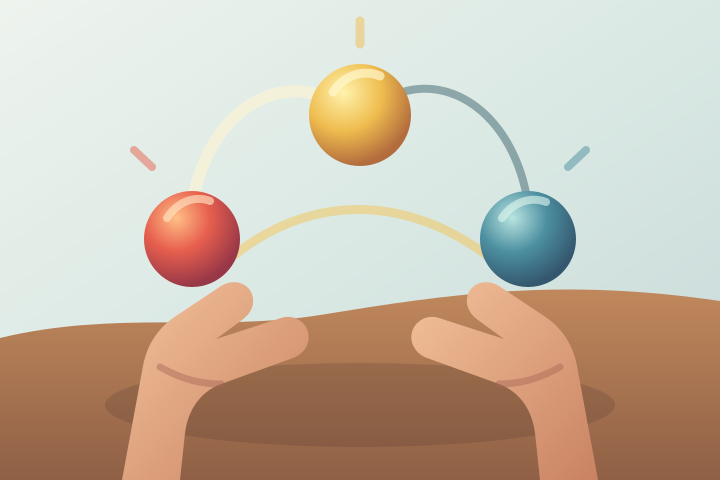
Juggling is the art of keeping several objects in the air at once by throwing and catching them in coordinated, repeating patterns. A beginner’s first session usually looks like this: hold three soft beanbags, practise tossing one object from hand to hand in a gentle arc, exchange two objects between your hands, and then attempt a continuous three-ball cascade — the basic pattern almost everyone learns first.
It suits people who enjoy coordination challenges, repetition, and progress that can be felt one clean catch at a time. The honest constraints: the first weeks are more about repeating one accurate throw than about juggling, drops are constant and normal, you need a clear space with room to throw above head height, and soft props wear out. It can be a quiet solo practice, a playful activity with friends, or a performance skill built around rhythm, creativity, and movement.
Decision Snapshot
| Beginner question | Practical answer |
|---|---|
| Best for | People who want a low-cost, coordination-based skill with visible, incremental progress and a strong performance and community side. |
| May dislike it if | You want instant results, dislike repetitive drilling, or don’t have a clear space to throw in. |
| Typical first-session cost | Almost nothing with household objects (rolled-up socks); a set of three beginner beanbags is typically $10–$20 / £8–£15. |
| Weekly time commitment | Twenty to forty minutes a few times a week builds the three-ball cascade; short daily sessions progress fastest. |
| Space requirement | A small clear area with room to stretch both arms and throw above head height; a bed or couch helps retrieval. |
| Which prop? | Soft beanbags or balls are the standard starting point; clubs and rings come later. |
| Fitness demand | Low: standing, with arm and hand coordination. It is one of the more accessible hobbies across a wide age range. |
| Social level | High once you’re past the basics: clubs, circus groups, conventions, and partner passing. |
Getting Started
Start with three soft objects. Beanbags are the usual first choice because they are light, slow, and easy to catch, but rolled-up socks work for a first try. The learning sequence is short and well established:
- One-ball toss — throw a single object from one hand to the other in a gentle arc, aiming near the opposite eye rather than straight across.
- Two-ball exchange — hold one object in each hand and pass them back and forth, keeping the rhythm even.
- Three-ball cascade — the basic pattern: throw one object, then the next as the first reaches its peak, letting the throws cross in front of you.
Keep throws around eye height and practise over a bed or couch so dropped objects do not roll away.
Where to learn:
- A local juggling club or circus group is the cheapest and fastest way to get feedback on your throws.
- Circus schools and community colleges often run beginner juggling or circus-arts classes.
- Free video tutorials are good for seeing throw height and timing; a practice partner or club member is better for correcting drift.
- The International Jugglers’ Association publishes community resources and runs an annual festival in the United States where beginners can try props, attend workshops, and meet other jugglers.
Basic Gear
| Item | Essential starter | Optional later | Avoid at first |
|---|---|---|---|
| Props | Three soft beanbags, or rolled-up socks for a first try. | Juggling balls, clubs, rings, scarves, bounce balls, or contact balls as you progress. | Hard, bouncy, or very large objects before your catches are relaxed. |
| Practice surface | A bed, couch, or uncluttered floor for easy retrieval. | A dedicated clear area outdoors or in a hall. | Busy walkways, low ceilings, or rooms full of fragile objects. |
| Clothing | Comfortable clothing that leaves your arms free. | Nothing much — clothing is the least important part of juggling kit. | Restrictive sleeves that limit your throw arc. |
| Instruction | A beginner tutorial, class, or practice partner. | Coaching, a club, or a convention. | Buying expensive props before your basic cascade is steady. |
How Juggling Works
Juggling patterns are built from a small set of throws. The three you will meet first:
| Pattern | Objects | What it looks like |
|---|---|---|
| Cascade | 3 (or any odd number) | The basic pattern: throws cross in front of you, alternating hands. Almost everyone learns this first. |
| Shower | 4 (or any even number) | One hand makes a high throw across, the other catches and makes a low throw back. |
| Fountain | 3 or more | A one-handed pattern: one hand throws high, the other catches and re-throws. |
A handful of terms cover most of what you will do. Learning them early makes coaching and club play much easier to follow.
| Term | What it means | Beginner note |
|---|---|---|
| Throw | Sending an object from one hand into the air. | Consistent throw height is the foundation of every pattern. |
| Catch | Taking an object out of the air with a relaxed hand. | A tight, tense hand makes catches clumsy; keep your fingers loose. |
| Cascade | The basic three-object pattern with crossing throws. | The first continuous pattern to learn. |
| Shower | The basic four-object pattern with one high and one low throw. | A natural next pattern after the cascade. |
| Fountain | A one-handed pattern. | Good for building one hand’s independence. |
| Columns | A pattern where objects travel in two separate vertical columns rather than crossing. | A common beginner variation of the cascade. |
| Undercross | A throw that passes under the arm or across the body. | Adds movement to a basic pattern. |
| Siteswap | A numeric notation that describes juggling patterns. | See below. |
| Prop | The object you juggle: ball, beanbag, club, ring, scarf, and so on. | Different props change the feel and difficulty. |
| Beat | One throw in the rhythm of a pattern. | Patterns are counted in beats. |
| Flash | A short, impressive display of many props, often at the end of a routine. | A performance term, not a practice skill. |
Siteswap. Jugglers describe patterns with a numeric notation called siteswap (also called “quantum juggling” or the “Cambridge notation”). Each number tells you how many beats an object stays in the air before it is thrown again. The three-ball cascade is written “3”, a shower is “51”, and the number of objects in a pattern is the average of its numbers — so “441” is a three-object pattern. Siteswap was invented by Paul Klimek in 1981 and developed in 1985 by jugglers and mathematicians at Caltech and in Cambridge; it is now the standard way the community names and shares patterns. It does not describe body movements such as behind-the-back or under-the-leg throws, and it assumes throws happen on evenly spaced beats.
First Session
Use the first session to build feel, not tricks. With three soft beanbags over a bed or couch:
- Toss one beanbag from hand to hand in a gentle arc, aiming near the opposite eye. Repeat until the arc feels the same every time.
- Hold one beanbag in each hand and pass them back and forth, keeping the rhythm even.
- Attempt the three-ball cascade: throw one, then the next as the first reaches its peak, letting the throws cross. You will drop a lot — that is normal.
- Stop after a few minutes of attempts, reset, and try again.
Stop while it is still fun. Ten to twenty minutes of clean practice beats an hour of frustration.
First Month
Practise in short, regular sessions. A simple progression:
| Week | Session focus | Practice drills | Success target | Watch for |
|---|---|---|---|---|
| Week 1 | One accurate throw. | One-ball tosses, two-ball exchanges. | A throw that lands in the other hand at the same height every time. | Throwing straight across instead of in an arc; rushing the rhythm. |
| Week 2 | The three-ball cascade. | Short cascade attempts, resetting after each drop. | A few clean three-ball sequences of five or more catches. | Tense hands; throws that drift forward. |
| Week 3 | Consistency and control. | Longer cascades, starting with either hand, stopping under control. | Ten or more catches in a row, and a controlled stop. | Chasing a dropped object instead of resetting. |
| Week 4 | Variations. | Columns, under-the-leg throws, a simple partner pass. | One variation that feels repeatable. | Reaching for tricks before the cascade is relaxed. |
Costs
Juggling can begin for almost nothing with household objects. As of mid-2026, typical starter ranges are:
| Item | Typical range | Note |
|---|---|---|
| Rolled-up socks | Free | A fine first try; they roll and are hard to catch consistently. |
| Three beginner beanbags | $10–$20 / £8–£15 | The standard first purchase; soft, slow, and easy to catch. |
| Three juggling balls | $15–$40 / £12–£30 | A step up in durability and feel; a good second purchase. |
| Three clubs | $20–$50 / £15–£40 | For later; clubs are harder to catch and need more space. |
| Three rings | $20–$40 / £15–£30 | For later; rings are light and fast. |
| Scarves | $10–$25 / £8–£20 | Slow and forgiving; good for a different feel. |
| Lessons or classes | Varies by venue | A few sessions early can save months of bad habits. |
| Convention tickets | Varies by event | Optional; a good way to try many props and meet the community. |
Prices vary by country, retailer, and exchange rates, so check local shops for current costs. The cheapest honest path is household objects or a set of beanbags until you know you will keep playing.
Space Needed
Basic ball juggling needs a small clear area with room to stretch both arms and throw above head height. Bedrooms, living rooms, gardens, parks, gyms, and community halls can all work. Low ceilings, ceiling fans, fragile objects, pets, and busy walkways make practice harder and less safe. Clubs and rings need a bit more room than balls because they are longer and faster.
Solo or Social
Most early practice is solo, but juggling becomes highly social through clubs, circus groups, skill-sharing sessions, conventions, festivals, and passing patterns. A practice partner can help identify throws that drift forward or sideways, while group sessions make it easy to try unfamiliar props before buying them. Partner passing — throwing objects back and forth between two jugglers — is one of the most social parts of the hobby and a natural next step after a steady solo cascade.
Common Mistakes
- Throwing each ball toward the opposite hand instead of upward in a crossing arc.
- Chasing forward-moving throws rather than resetting the pattern.
- Starting with objects that are hard, bouncy, or too large to catch comfortably.
- Practising for too long after concentration and accuracy have faded.
- Reaching for tricks before the basic cascade is relaxed and repeatable.
- Tensing the catching hand, which makes catches clumsy and drops more likely.
Safety / Accessibility
Juggling is low-impact, but it has a few real concerns. Dropped props can hit a bystander’s face or eye, and long sessions can strain the wrist, elbow, or shoulder. Use soft, light props at first, practise away from faces, windows, screens, hot drinks, pets, and moving people, and keep the area behind you clear. Stop if your hands, wrists, elbows, shoulders, or neck become sore.
| Risk or access need | Practical adaptation |
|---|---|
| Dropped props near a face | Practise with soft beanbags, keep a clear space, and never juggle directly in front of another person’s face. |
| Wrist, elbow, or shoulder strain | Keep sessions short at first, use a relaxed grip, and take breaks. |
| Limited reach or mobility | Seated practice, fewer objects, and slower patterns are all workable. |
| Low vision | Larger, high-contrast balls and a quieter practice space help. |
| Different coordination needs | Scarves, larger high-contrast balls, and bounce juggling on a suitable surface can adapt the hobby. |
Where It Can Go
Juggling can stay a casual solo practice or become a long-term performance skill. The main changes are prop variety, session frequency, coaching, and how much you want to perform.
| Path | What changes | Cost and time | Skill focus |
|---|---|---|---|
| Casual solo practice | Relaxed sessions, household or beanbag props. | Almost nothing. | Consistent throws and a steady cascade. |
| Club or circus group | Regular practice with others, partner passing, a community. | Low; often free or a small fee. | Passing, variations, and feedback. |
| Circus arts | Juggling as part of a broader circus skill set, often with a school or troupe. | Class or school fees. | Combining juggling with movement, balance, and performance. |
| Street performance | Performing in public for an audience. | Minimal; local permits may apply. | Routine, audience awareness, and confidence. |
| Stage and competition | Routines, shows, or judged events. | More practice, possible event fees. | Polished routines, timing, and presentation. |
| Prop making | Making your own beanbags, clubs, or rings. | Materials. | Practical craft knowledge. |
| Teaching | Coaching others or running a class. | Time; possible certification. | Clear instruction and patience. |
References
Last reviewed: 18 August 2026.
Editorial note: This page is written as beginner discovery guidance, not as a maintained product ranking. Prop prices are typical starter ranges and vary by country, retailer, and exchange rates; check local shops for current costs.
Official and institutional sources:
- International Jugglers’ Association — a nonprofit juggling organisation with educational resources, community programmes, and an annual festival.
- IJA Festival — the International Jugglers’ Association’s annual gathering, with workshops, shows, and open juggling.
- Wikipedia, Siteswap — the numeric juggling notation, its origin (invented by Paul Klimek in 1981, developed in 1985 at Caltech and in Cambridge), and how patterns are described.
Community resources (optional):
- Your local juggling club or circus group, found through community listings or a local arts centre, for regular practice and feedback.
- Free video tutorials for seeing throw height and timing; a practice partner or club member is better for correcting drift.
Related Hobbies
Yo-yoing, cardistry, magic tricks, dance, puppetry, slacklining, drumming, speedcubing, stand-up comedy, and video editing all connect with juggling through timing, dexterity, rhythm, practice, or performance.