Who It Suits
Bocce is a precision lawn game: two teams of one to four players each take turns throwing heavy balls (typically 920-1000 g) down a long, narrow court, aiming to land them as close as possible to a small white target ball called the pallino. In a typical first game you learn the underhand roll, throw the pallino 6-10 m down the court, and alternate rolling your balls in; most beginners can play a full, properly scored game within a single session.
Bocce suits people who want a social, low-impact game that rewards placement and reading the court rather than raw power or speed. The pace is relaxed, the throws are gentle, and the strategy is approachable: you can play “point” (defending your winning ball) or “stack” (piling balls on top of the pallino) from the very first game. The main constraints: you need at least one opponent, a long flat surface, and a set of balls, and wind can affect lobs on open courts.
Bocce descends from the Greek ball game spheristics, played as far back as the 7th century BC, and was developed into its modern form in Italy, where the name comes from the Italian bocce (balls). It is played worldwide under the rules of the International Bocce Federation (FIBV), and its adapted form, boccia, is a Paralympic sport.
Decision Snapshot
| Question | Short answer |
|---|---|
| Best for | People who want a relaxed, social lawn game with simple rules and a real strategy layer. |
| May not suit | People who need to practise alone, want fast continuous action, or lack a long flat surface. |
| Typical first-session cost | Often free at parks and clubs; a starter set of 8 balls plus pallino is typically $50-$150 / £40-£120 to share. |
| Weekly time | One 60-90 minute game is enough to start; most casual players play once a week. |
| Space | A flat court 15-20 m long and 3-4 m wide; a long driveway, park lane, or beach works too. |
| Indoor or outdoor | Both; outdoor on gravel, sand, or turf, indoor on smooth floors. |
| Fitness level | Gentle; mostly walking and throwing, with no chasing the ball. |
| Solo or social | Social; games need at least one opponent, solo practice is limited to throwing repetition. |
Getting Started
The smallest sensible first step is a casual game in a park or at a club: borrow a set of balls, learn the underhand roll, and play a full game to 12 with other beginners.
- Find a club or regular group: the United States Bocce Federation lists US clubs and events, while parks, community centres, Italian cultural organisations, and lawn-bowls clubs may know of local play elsewhere.
- Read the core rules before your first game: throwing the pallino 6-10 m down the court, alternating throws, and scoring by closeness. FIBV’s rules summary is a short read.
- Borrow a set of balls for the first few games; buy one once you know you will keep playing.
- If you want structure, ask about a league, ladder, or coaching pathway; most clubs run these.
Basic Gear
| Item | Essential starter | Optional later | Avoid at first |
|---|---|---|---|
| Balls | A borrowed set of 8 balls (4 per colour) plus a pallino, or a starter set (typically $50-$150 / £40-£120) | A matched set of 4 balls in your own colour, sized to your hand | Expensive competition sets before you have learned basic control |
| Measuring | A soft tape measure or a “bocce measure” for close calls | A dedicated FIBV measuring device | Relying on guesses for close points |
| Shoes | Flat, grippy shoes or trainers | Court shoes for smooth indoor floors | Heels or slippery soles on gravel |
| Clothing | Comfortable movement clothing | A cap or sun protection for outdoor summer games | — |
| Other | Water bottle, a small bag for the balls | A ball bag or trolley for transport | — |
Balls must meet FIBV specifications for competition play (diameter 107-110 mm, weight 920-1000 g), but for casual play any smooth, heavy balls of similar size are enough.
How Bocce Works
| Element | What it means |
|---|---|
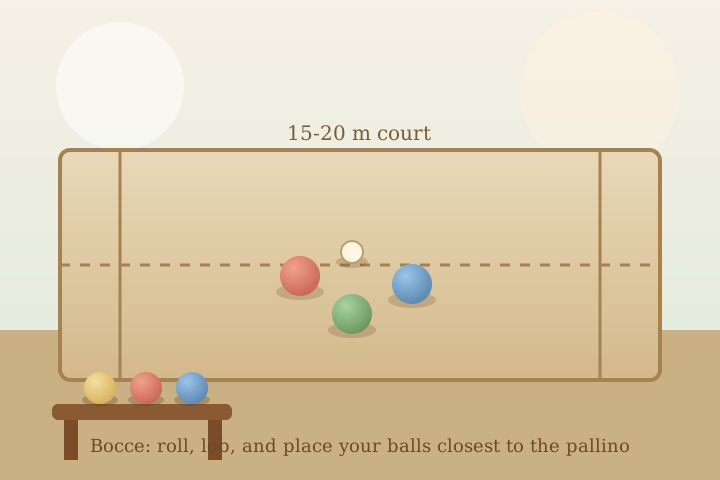
| Court | 15-20 m long and 3-4 m wide, flat and level, with a throwing line at each end. |
| Pallino | A small white target ball (30-32 mm) thrown first, landing 6-10 m from the throwing line. |
| Teams | One to four players per side: singolo (1v1), doppio (2v2), triplo (3v3), or quadruplo (4v4). |
| Turn order | The team that throws the pallino throws first; afterwards the team that is not closest to the pallino throws next. |
| Throw | Each player throws all of their balls (usually 4) over the throwing line, underhand, overhand, or sidearm. |
| Scoring | After all 16 balls are thrown, the team with the ball closest to the pallino scores 1 point for each of its balls that is closer than the opponent’s best ball. |
| Game length | Games are usually played to 12 points; tournaments may use different formats. |
| Common faults | Pallino landing outside the 6-10 m zone (re-thrown), throwing before the previous ball has stopped, or a ball that does not cross the throwing line. |
The closeness rule is what makes bocce different from bowling or croquet: you are not knocking things down or chasing a ball, but placing yours and reading where the pallino will settle.
Core Throws and Vocabulary
| Term | Plain English |
|---|---|
| Pallino (pallina) | The small white target ball everything is thrown around. |
| Roll (underhand) | A low, flat throw that keeps the ball close to the ground; the most reliable beginner throw. |
| Lob (overhand) | A high arcing throw used to reach over a stack of balls or cover more distance. |
| Sidearm | A throw from the side of the body, used for placement around obstacles. |
| Point | Playing defensively: keeping your ball closest to the pallino. |
| Stack | Playing offensively: piling your balls on top of the pallino so the opponent must knock them away. |
| Knock (shot) | A harder, flatter throw aimed at removing an opponent’s ball from the pallino. |
| Measure | Measuring the distance from a ball to the pallino to settle a close point. |
| Vetto | The player who throws the pallino, usually the team captain. |
Court Dimensions and Space
| Measurement | Size |
|---|---|
| Court length | 15-20 m (49-66 ft) |
| Court width | 3-4 m (10-13 ft) |
| Pallino landing zone | 6-10 m from the throwing line |
| Bocce ball diameter | 107-110 mm (competition) |
| Bocce ball weight | 920-1000 g (competition) |
| Pallino diameter | 30-32 mm |
| Balls per set | 8 (4 per team colour) plus 1 pallino |
A court can be marked on gravel, sand, turf, or a smooth hard surface; the surface changes how the ball rolls, so players adjust their throw to match.
Visual Examples
First Session
Warm up with a few easy rolls to a spot on the ground, then throw the pallino and play a full game to 12. Focus on a consistent underhand roll: a smooth swing, a release at waist height, and a follow-through along the court. A good first session ends with a couple of complete games, even if the scorekeeping is rough and a few points need measuring.
First Month
Play once a week if possible. Keep early sessions short enough that your shoulder and back stay fresh.
| Week | Session focus | Practice drills | Success target | Watch for |
|---|---|---|---|---|
| Week 1 | The underhand roll and throwing the pallino. | 10 minutes of rolls to a spot on the ground, 10 minutes of pallino throws to land 6-10 m out, then two full games to 12. | Land 5 of 10 rolls within a ball’s width of the spot. | Chopping down on the ball, releasing too early, and aiming with the shoulder instead of the wrist. |
| Week 2 | Distance control. | 10 minutes of rolls, 15 minutes of rolls at three different distances (near, mid, far), 20 minutes of games to 12. | Hit the mid distance 6 of 10 times. | Overthrowing when nervous, and not adjusting for a ball that rolls fast or slow on the surface. |
| Week 3 | Point and stack decisions. | 10 minutes of rolls, 15 minutes of deliberate point throws, 15 minutes of stack throws, 20 minutes of games where you choose point or stack before each throw. | Make a deliberate point-or-stack choice on every throw. | Defaulting to point every time, and stacking too high so the ball rolls off the pallino. |
| Week 4 | Knocking and reading the court. | 10 minutes of rolls, 15 minutes of controlled knock practice on a spare ball, 25 minutes of games to 12 with proper measuring of close points. | Remove an opponent’s ball with a knock at least twice. | Hitting knocks too hard, and arguing close points instead of measuring them. |
Rotate partners and sides when you can; different players quickly teach you pace, placement, and when to play point or stack.
Costs
Bocce is affordable if you share a set of balls and play on public surfaces. Parks, beaches, and community courts are often free, and many clubs run open play without membership. The main cost is a set of 8 balls plus a pallino, typically $50-$150 / £40-£120, which a group can share. Costs rise with a personal set of 4 balls, a ball bag or trolley, a measuring device, and club fees.
A cautious first-month budget is often $0-$30 / £0-£25 if you borrow balls and play in parks, or $60-$180 / £50-£150 if you buy a shared starter set. Prices vary widely by country and venue.
Space Needed
Bocce needs a flat, level surface 15-20 m long and 3-4 m wide, with clear space at both ends for throwing. A marked court is ideal, but a long driveway, a park lane, a beach, or a smooth indoor hall all work. The surface matters more than the markings: gravel, sand, turf, and hard floors each change how the ball rolls, so players adjust their throw to match. Storage is easy; a set of 8 balls and a pallino fits in a small bag.
Solo or Social
Bocce is strongly social. Doubles and foursomes, open play, ladders, leagues, clubs, and casual park groups make the hobby easy to repeat, and most clubs welcome beginners at mixed-ability games. Solo practice can help with roll consistency against a spot on the ground and pallino distance control, but real games need at least one opponent.
Common Mistakes
- Chopping down on the ball instead of using a smooth, level release.
- Aiming with the shoulder instead of keeping the wrist and forearm aligned with the target.
- Throwing the pallino too close or too far, outside the 6-10 m zone.
- Playing point every time and never trying a stack or a knock.
- Hitting knocks too hard, which sends the ball past the pallino.
- Arguing close points instead of measuring them.
- Playing on an uneven surface where the ball rolls unpredictably.
Safety / Accessibility
Bocce is one of the gentlest court games: the main concerns are a strained shoulder or back from repetitive throwing, slips on uneven or wet surfaces, and heat on outdoor courts. Warm up, use grippy shoes, choose a level surface, and take breaks during long sessions. Boccia, the adapted Paralympic form of the game, shows how widely the game can be played.
| Risk or access need | Practical adaptation |
|---|---|
| Limited mobility | Boccia is a Paralympic sport with its own rules and equipment; seated play is common in casual games too. |
| Older players | The gentle pace, no chasing, and low-impact throws suit players who find racket sports demanding. |
| Children | Smaller, lighter balls and a shorter court make the game approachable; supervision applies. |
| Shoulder or back concerns | Use a lighter ball, keep throws short, and favour the roll over the lob. |
| Heat | Outdoor courts in summer need shade, water, and shorter sessions; check your local guidance. |
| When to start with coaching | Use coaching if you have previous shoulder or back concerns, or if you want to join club games quickly. |
Bocce Compared With Nearby Hobbies
| Hobby | Court / space | Ball / projectile | Typical first cost | Best when |
|---|---|---|---|---|
| Bocce | 15-20 m × 3-4 m court | Heavy ball (920-1000 g) plus a small pallino | Low (share a set of 8 balls) | You want a gentle, social lawn game with placement strategy. |
| Lawn bowls | A long, narrow green | Biased bowl | Moderate (bowls plus green hire) | You want a similar closeness game on a prepared green. |
| Croquet | A large flat lawn | Small ball and mallet | Low | You want to knock balls through wickets rather than place them. |
| Petanque | An open gravel area | Metal balls thrown underhand | Low | You want a casual, no-court version of the same idea. |
| Bowling | A long lane with pins | Heavy ball | Moderate (lane fees) | You want a structured, machine-scored alley game. |
Where It Can Go
| Path | What it looks like |
|---|---|
| Casual park play | Regular games in parks, on beaches, or in community spaces with rotating partners. |
| Club and league | Joining a local club and playing a ladder, league, or federation event. |
| Tournaments | Sanctioned tournaments from local events to FIBV World Championships. |
| Coaching | Club coaches and FIBV coaching pathways for players who want to improve. |
| Boccia | The adapted Paralympic form of the game, with its own rules, equipment, and competitions. |
| Cross-training | Lawn bowls, petanque, croquet, or a steady social fitness routine. |
Frequently Asked Questions
Do I need to be athletic to play bocce?
No. The game is mostly walking and gentle throwing, with no chasing the ball. Many players start in their 50s, 60s, or later, and boccia, the adapted form, is a Paralympic sport.
What is the difference between bocce and petanque?
Both are closeness games with heavy balls, but bocce is played on a marked court (15-20 m long) with larger, lighter balls (920-1000 g) and a formal scoring system, while petanque is played on open gravel with smaller steel balls and looser, casual rules.
Can I play bocce indoors?
Yes. Bocce is played on smooth indoor floors in halls and community centres, and the same rules apply. The ball rolls differently on a hard floor than on gravel or turf, so you adjust your throw to match the surface.
Do I need to join a club or pay membership to play?
No. Parks, beaches, and community spaces are often free, and many clubs run open play without membership. Club membership mainly matters for league play and tournaments.
How many people do I need to play bocce?
At least two, for a singolo (1v1) game. Most casual games are doppio (2v2), and teams can have up to four players (quadruplo).
References
Last reviewed: 18 August 2026.
Editorial note: This page is written as beginner discovery guidance, not as a maintained product ranking. Court dimensions, ball specifications, and scoring vary between formal rule sets and casual play; confirm the rules with the organiser before a league or tournament. Session fees and gear prices are typical starter ranges and vary by country, venue, season, and exchange rates; check local clubs for current costs.
Official and institutional sources:
- United States Bocce Federation — the US federation for several forms of bocce, with club, event, and national-team information.
- USBF Rules — formal and open-play bocce rules, tournament information, and equipment guidance.
Related Hobbies
Lawn bowls, petanque, and croquet share the closeness-and-placement mindset, while bowling shares the roll-and-score feel. Walking, hiking, and other gentle movement hobbies support the steady, low-impact routine that bocce builds.